


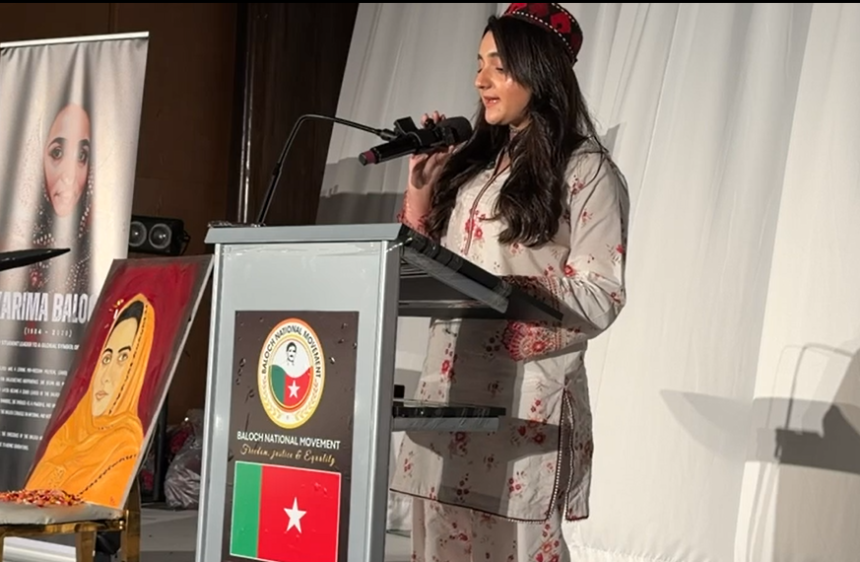
A seminar was organized in London by the Baloch National Movement (BNM) to mark the fifth martyrdom anniversary of Banuk Karima Baloch. Addressing the seminar, Brakhna Sayyad, a member of the Pashtun Tahafuz Movement (PTM), said that military operations, collective punishment, arbitrary arrests, enforced disappearances, and extrajudicial killings have become a part of everyday life in Pashtun regions. She emphasized that Karima Baloch’s courage reminds us that the truth must be spoken, even in the face of terror.
She stated that Karima Baloch was not merely a leader, but a beacon of hope for all those who had been silenced, oppressed, and ignored.
“As the first female chairperson of the Baloch Students Organization, she shattered barriers that were long considered unbreakable. She raised the voice of Baloch women, spoke relentlessly against enforced disappearances, and fearlessly challenged powerful forces despite constant threats to her life. Her courage was not accidental; it was a conscious choice shaped by pain, loss, and continuous injustice,” she said.
Representing the Pashtun nation, Brakhna Sayyad noted that in recognition of her fearless struggle, the BBC included Karima Baloch among the world’s 100 most inspirational women. Although living in exile in Canada and far from her homeland, Karima Baloch never abandoned the struggle for her oppressed Baloch nation. She exposed enforced disappearances, extrajudicial killings, and systematic oppression carried out by the Pakistani state, its military, and intelligence agencies, particularly the ISI.
Rejecting the claims made by Canadian police regarding Karima Baloch’s death, Brakhna Sayyad said that even in exile, Karima Baloch remained a strong and unwavering voice for justice. Tragically, in December 2020, her body was found near Toronto’s waterfront. While official reports declared her death non-criminal, for thousands of supporters worldwide, her death remains a painful reminder of how truth-tellers are silenced.
She further stated that Karima Baloch’s martyrdom was a great loss, but her courage, wisdom, and resistance remain alive. Her legacy did not end with her death. Mahrang Baloch continues her vision, ensuring that Shaheed Karima Baloch’s memory does not fade and that the struggle for truth, justice, and accountability continues. The courage of both leaders delivers a powerful message: fear cannot end a movement; it only reveals its strength.
Speaking about enforced disappearances in Balochistan and Pashtunkhwa, she said that for decades, thousands of Baloch and Pashtun students, activists, nationalists, women, and even children have been forcibly disappeared. Families wait for years, uncertain whether their loved ones are alive or dead. These enforced disappearances— carried out by the Pakistani military and intelligence agencies—have destroyed countless lives. She stressed that the pain of the Baloch and Pashtun nation is deeply interconnected.
Brakhna Sayyad added that leaders such as Karima Baloch, Mahrang Baloch, Manzoor Pashteen, Gilaman Wazir, and Ali Wazir teach us that the struggle for justice demands courage—and sometimes sacrifice. They prove that the voices of the oppressed cannot be silenced, regardless of how much force is used against them.
“We need leaders like Karima Baloch. We need leaders like Mahrang Baloch. We need movements like the Pashtun Tahafuz Movement that fearlessly advocate for the rights and freedoms of all oppressed nations—not only Pashtuns. These leaders remind us that justice is never granted; it is claimed by those brave enough to demand it,” she said.
Concluding her address, Brakhna Sayyad expressed solidarity with the Baloch nation, stating, “From this stage today, I assure the Baloch nation that we, the Pashtuns, stand with you. We support Baloch nationalism and your rightful struggle. United, we stand together—because our enemy is the same, and our resistance must be shared.”
