
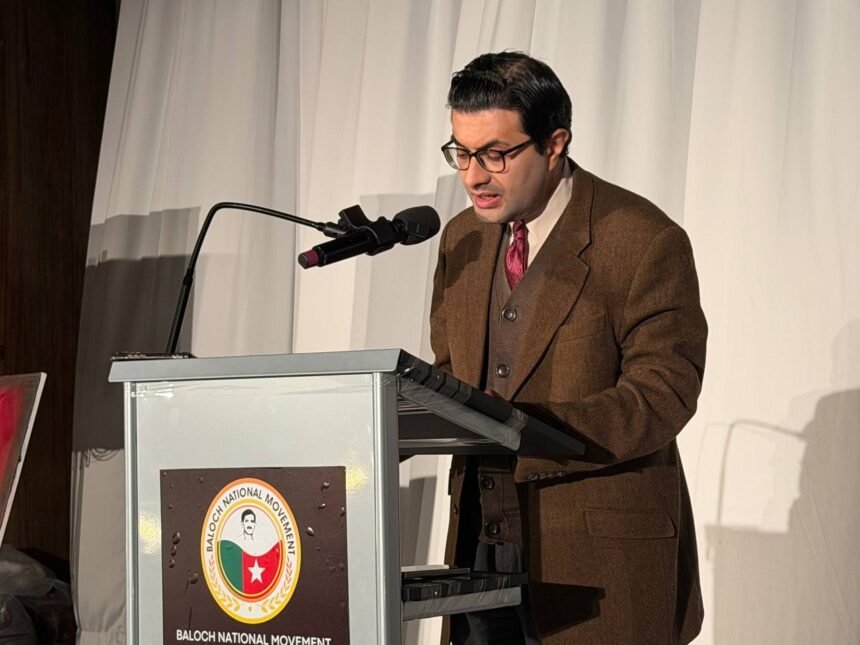
Burzine Waghmar, a scholar of Iranian Studies at the University of London and a member of the SOAS South Asia Centre, strongly criticized Pakistan’s human rights record while addressing a seminar organized by the Baloch National Movement (BNM). He stated that, according to the Human Rights Commission of Pakistan (HRCP), elements of Pakistan’s deep state have been actively involved in fomenting sectarian terror and violence in Balochistan and then attributing that violence to the very oppressed minority it targets.
He asserted that the same Pakistani deep state is also responsible for the murder of Karima Baloch—an act that remains a mystery for Canadian authorities, but not for those who have long understood the realities behind such crimes.
These remarks were made during a seminar held in London on Saturday in memory of Banuk Karima. The seminar was organized by the Baloch National Movement to mark the fifth anniversary of her martyrdom, and was attended by intellectuals and political activists who shared their reflections on her life and struggle.
During his address, Burzine Waghmar expressed dissatisfaction with the role of Canadian authorities, particularly the police, noting that while they have been unable to determine the circumstances surrounding Karima Baloch’s death, they might at least attempt to resolve the mystery surrounding the disappearance of PIA cabin crew members. He pointed out that Pakistan International Airlines now operates only one North American route—to Toronto—after flights to Chicago, Houston, and New York were discontinued.
PIA itself has acknowledged that in 2025 alone, three cabin crew members disappeared on the Toronto–Lahore (PK-784) route. Similarly, in 2024, three crew members failed to report for duty on the Toronto–Karachi (PK-784) flight. This pattern, he remarked, suggests a peculiar aversion among Pakistanis toward both cities—whether the country’s cultural capital or its financial hub.
Waghmar stated that humanity has reached a point where restating obvious truths has become the foremost duty of conscious individuals. If liberty has any meaning, he said, it lies in the right to tell people what they do not wish to hear. In times of universal deceit, speaking the truth becomes a revolutionary act. As George Orwell reminds us, reiterating uncomfortable yet familiar truths is essential—especially as the world marks the fifth anniversary of Karima Baloch’s death.
According to him, Pakistan’s international impunity allows it to act fearlessly not only within its borders but also beyond them, assassinating peaceful Baloch activists in exile and considering itself above the law. The unresolved murders of Karima Baloch in Canada and Sajid Hussain in Sweden expose the reluctance of host governments to hold Islamabad accountable.
Recalling Karima Baloch once again, Waghmar said the situation remains deeply troubling, with two recent developments posing even greater dangers for the long-suffering Baloch nation. The exchange of drone strikes and missile attacks between Iran and Pakistan has placed Baloch communities directly in the line of fire. Next month marks the second anniversary of the attacks carried out between 16 and 18 January 2024. Both Islamic republics, he noted, discriminate against the Baloch as an ethnolinguistic minority.
He drew attention to the discriminatory treatment of Baloch people in both Iran and Pakistan. In Iran, he explained, discrimination is directed at Sunnis living in the country’s largest, least developed, and only Sunni-majority province. Tehran’s claim that it is combating Deobandist Takfiri elements, he said, is unconvincing and largely rejected by scholars of Iranian studies.
Waghmar further stated that Pakistan’s predominantly Sunni Hanafi Punjabi elite, despite sectarian similarities with the Baloch, harbor deep hostility toward them and unhesitatingly pursue a “pick-up and dump” policy. Under this policy, not only human rights activists but also apolitical, innocent Baloch civilians—including women and children—are killed. While both states accuse each other of harboring separatists, the identities of these alleged separatists and the sources of their patronage are never disclosed.
He also highlighted the apathy within Pakistani society, noting that the lack of public outrage—particularly in the context of the 7 October massacres—reveals selective moral concern. This indifference extends not only toward the Baloch but also toward Uyghur Muslims, who are similarly deemed unworthy of attention.
In the same year marking Karima Baloch’s fifth death anniversary, Waghmar noted, Pakistan reportedly surpassed Afghanistan as the world’s largest source of opium, according to The Daily Telegraph (London, 6 September 2025). He observed that little attention is paid to how the millions of dollars generated through opium trafficking may be used to finance human smuggling or terrorist organizations, effectively turning Balochistan into a safe haven for the deep state’s covert, profit-driven activities.
Raising further concerns, he questioned whether lobbying by the Toronto-based Canadian mining company Barrick Gold may have played a role in suppressing a serious investigation into Karima Baloch’s death. It is difficult, he argued, to believe that Islamabad did not exert pressure on the company to avoid treating the case as foul play. The absence of evidence, he emphasized, is not evidence of absence.
Exposing Barrick Gold’s exploitative global record, Waghmar recalled that in 2019, Chile’s environmental court permanently shut down the company’s Pascua Lama mining project—at least on the Chilean side of the border. He drew parallels between Pascua Lama and Reko Diq in Balochistan: both are remote, resource-rich, and environmentally fragile regions. Barrick Gold owns the mining concessions at Pascua Lama, 75 percent of which lie within Chile, and had planned to extract vast quantities of gold, silver, and copper over 17 years.
He explained that these deposits lay beneath three Andean glaciers that feed the Huasco River, the lifeline of Chile’s arid Atacama region—paralleling the dry and desiccated conditions of Balochistan. The valley, known as the “Garden of Atacama,” is home to approximately 70,000 people, including indigenous communities.
For mining to proceed, land belonging to the Yaguita communities was confiscated and residents displaced. In 2010, these communities petitioned the Inter-American Commission on Human Rights, arguing that Chile’s approval of the mining project amounted to expropriation of ancestral lands. Barrick Gold even proposed removing glacial ice to access underlying gold—an environmental catastrophe narrowly averted.
Waghmar further noted that the Financial Times Weekend (25–26 October 2025) reported Mali’s decision to reopen a gold mine against Barrick Gold’s wishes. The company had closed the mine in January 2025 after the Malian government—holding a 20 percent stake—transferred gold from the Gounkoto mine to a custodial bank. Barrick Gold subsequently initiated arbitration proceedings at the World Bank’s International Centre for Settlement of Investment Disputes (ICSID).
He pointed out that Mali’s military leadership, which came to power following the August 2020 coup, enacted legislation in 2023 increasing state ownership from 20 to 35 percent. Unlike Pakistan’s rulers in Rawalpindi and Islamabad, Mali’s leadership, he argued, has demonstrated the resolve to confront multinational corporations in what it perceives as the national interest.
Concluding his speech, Waghmar criticized international financial assistance to Pakistan, stating that silence can not only be outsourced but also purchased. And for how much? Precisely $700 million—the amount provided by the World Bank and the International Finance Corporation as a so-called concessional loan for the development of Reko Diq.
