
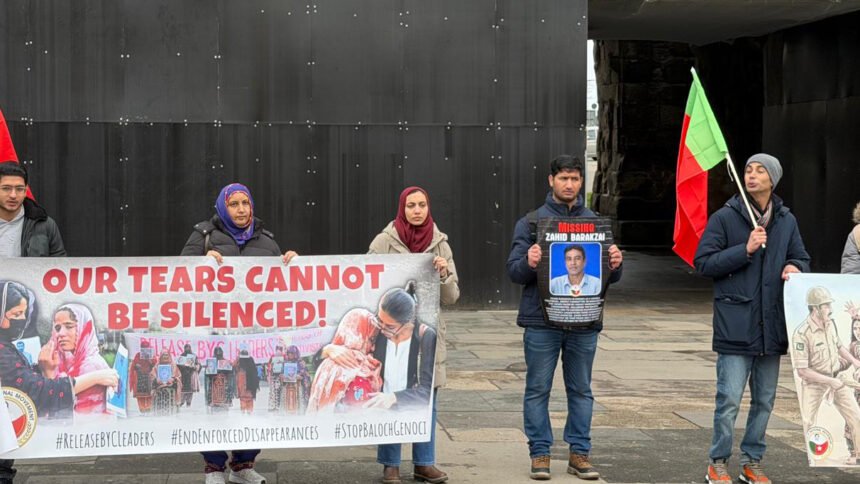
The Baloch National Movement (BNM) organized a protest demonstration at Porta Nigra Square in the German city of Trier to draw international attention to the systematic and grave human rights violations ongoing in Balochistan.
Human rights activists and supporters of the Baloch nation participated in the demonstration. Expressing solidarity with the people of Balochistan, the protesters voiced serious concern over enforced disappearances, extrajudicial killings, arbitrary arrests, and state repression against political dissenters and human rights activists. The participants stated that these actions are being carried out in an organized manner by the Pakistani state.
Through placards, banners, and speeches, the protesters urged the international community, global human rights organizations, and the media to break their silence on the situation in Balochistan. Speakers emphasized that despite decades of documented and persistent human rights abuses, the suffering of the Baloch nation continues to be ignored on international platforms.
During the protest, BNM activists also distributed of pamphlets in German and English.
The demonstration highlighted the severe impact of these abuses on women, children, and the families of enforced disappearances. Speakers noted that the families of the disappeared—especially mothers and children—have been demanding justice and the safe return of their loved ones through peaceful struggle for years, yet they are being subjected to collective punishment instead of receiving justice.
Speakers including Luqman Baloch, Wajahat Baloch, Asif Baloch, Mujeeb Abdullah, Shariq Baloch, and Habib Baloch strongly condemned the enforced disappearances, extrajudicial killings, and collective punishment faced by the people of Balochistan.
The speakers also sharply criticized the actions of the Pakistan Army, stating that it is using force against civilians in Balochistan. In recent days, dozens of people have reportedly been killed by direct military action in Gwadar, Mastung, and Kech, while civilians have also been killed in drone strikes. Protesters said these circumstances place a responsibility on the international community to reassess military and economic aid, defense partnerships, and arms sales to Pakistan.
Highlighting one of the worst forms of collective punishment, the protesters stated that the families of human rights defenders and political activists in Balochistan are also being subjected to enforced disappearances. They cited the recent enforced disappearances of Muhammad Bakhsh Sajdi (father), Naeem Sajdi (uncle), and Rafiq Baloch (maternal uncle) of BNM Chairman Dr. Naseem Baloch. According to the protesters, these arrests are intended to pressure the BNM chairman into abandoning his political activities.
They further stated that Dr. Naseem’s family has long been subjected to relentless Pakistani state repression. Several of his close relatives were forcibly disappeared for years, and one family member was extrajudicially killed during a home raid. In recent days, the families of other BNM leaders and activists have also faced harassment.
The speakers stated unequivocally that BNM leaders and activists will not be intimidated by such tactics employed by the Pakistan Army.
The protesters also mentioned the arrest of prominent lawyer Imaan Mazari and her husband Hadi Ali Chatha, stating that collective punishment in Balochistan is not limited to the families of Baloch activists but also extends to their lawyers and human rights defenders. They said Imaan Mazari and Hadi Ali Chatha were detained for speaking out against atrocities in Balochistan and for representing cases of enforced disappearances.
The protesters demanded that the United Nations, the European Union, and international human rights bodies conduct independent investigations into the human rights violations in Balochistan and hold those responsible accountable under international law.
