


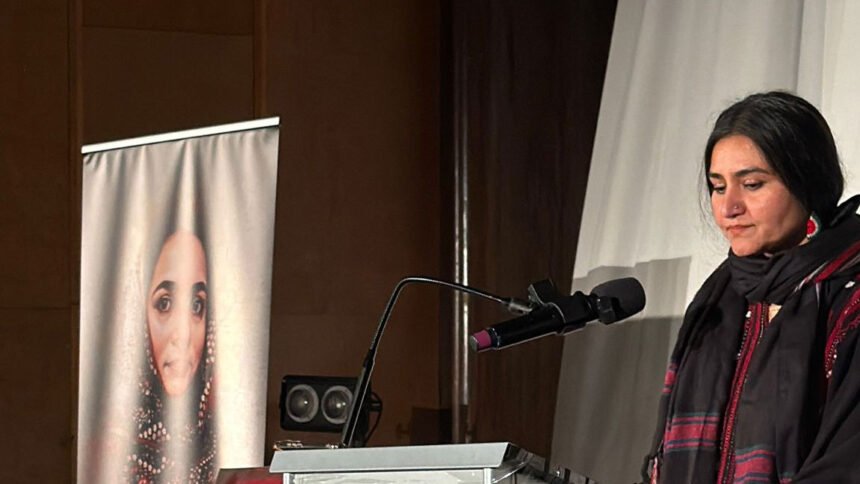
Prominent human rights activist and supporter of the Baloch movement, Noor Maryam Kanwar, while addressing a seminar organized by the Baloch National Movement (BNM) , stated that one of the most brutal manifestations of state violence is collective punishment , which the Baloch nation is forced to endure for resisting oppression. She cited the recent case of Mahzaib Shafiq, a young girl whose father was abducted by the state merely because she raised her voice against elitism and Pakistan’s military aggressions .
The seminar was held in London to mark the fifth anniversary of the martyrdom of Banuk Karima Baloch.
Noor Maryam emphasized that, alongside aggression, there exists extraordinary resilience within Baloch society and the Baloch nation. Despite relentless state violence and extreme hardships, the Baloch nation has not only endured but has continued its resistance against the injustices imposed upon it.
“In my view, the Baloch Women’s Red March is unique in its very essence. It made history and captured global headlines, drawing international attention to one of the most neglected causes in the world—Balochistan. Analysts, scholars, and others may interpret it in their own ways, and serious efforts are already underway to study this powerful women-led red movement that has emerged from a largely unheard cause in South Asia.”
She further stated that she views this march as a continuation of Karima’s struggle—a path forward and, in many ways, an extension of Karima’s resistance against the Pakistani state, which ultimately forced her into exile. Those who knew Karima, she said, are aware that she was the first woman to go door to door, persuading people—especially women—to actively participate in politics. She was mobilizing communities at a time when the Baloch movement was facing intense state repression.
Despite living in a patriarchal society, Noor Maryam noted, Karima traveled extensively from Turbat to Awaran, organizing women and communities and encouraging them to unite. She even urged families to register FIRs against those responsible for enforced disappearances imposed by the Pakistani state.
Remembering Karima Baloch, Noor Maryam said that she deeply admired her even before meeting her. “She was a woman whom the Pakistani military considered a threat—someone who openly challenged its brutal state machinery. I often wondered what kind of person she would be.”
Recalling her first meeting with Karima, Noor Maryam added that what left the strongest impression on her was Karima’s radiant smile, compassion, feminine dignity, and sparkling eyes. Those who knew Karima, she said, would readily attest to this—and even those who did not know her personally could see it reflected in her eyes. While resisting state oppression in Pakistan, Karima was forced to live in hiding, due to the grave threats she faced.

