


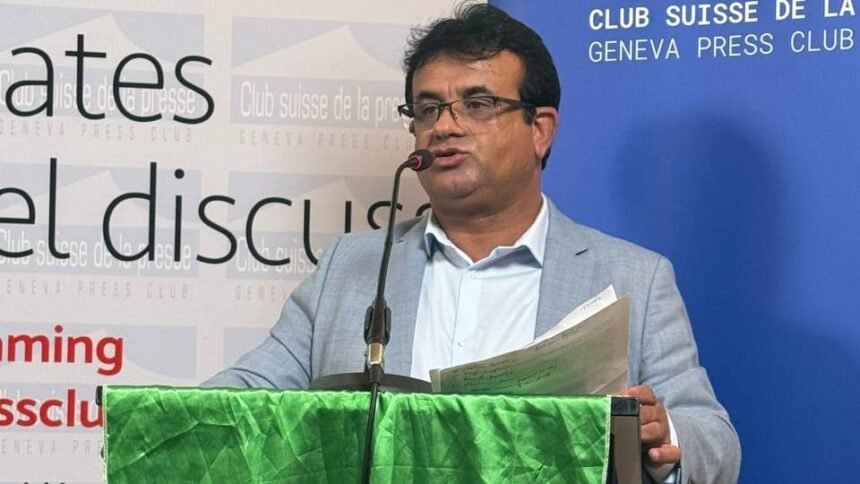
Dr. Naseem Baloch said that no foreign investment or project in Balochistan will be allowed without the consent of the Baloch nation.
“It does not matter which country seeks to impose its interests; whether regional or global powers, no state has the right to exploit our homeland against our will. The wealth of Balochistan belongs to the Baloch nation, and only we will decide how it is used,” he stated.
Speaking at the 7th Balochistan International Conference in Geneva, the Chairman of the Baloch National Movement (BNM) referred to history, saying that “Balochistan is not a creation of recent history. It has long possessed a distinct political identity, with a history of autonomy and treaty relations that existed well before the emergence of Pakistan. The sovereign status of the Baloch nation was acknowledged in formal agreements between the British colonial authorities and the Khan of Kalat, ruler of the Baloch State of Kalat.”
He recalled: “In 1876, the British signed a treaty with the Khan of Kalat, recognising Kalat as an independent state under British control with limited obligations in defence and foreign policy. Crucially, the British never annexed Kalat nor integrated it into British India. The relationship remained that of two separate political entities bound by treaty.”
Dr. Naseem added that when the British withdrew in 1947, “Kalat declared independence on 11 August 1947 — days before the creation of Pakistan. For a short but significant period, Kalat functioned as an independent state, with its own parliament, foreign policy, and diplomatic negotiations.”
But on 27 March 1948, Pakistan invaded and occupied Balochistan. This forced annexation was carried out despite the fact that both the upper and lower houses of the Kalat Parliament had rejected any proposal of accession. That act of aggression sparked immediate resistance, and since then, the Baloch movement has never accepted Pakistan’s claim over our land. We regard the 1948 accession as nothing more than an act of unlawful occupation.”
He noted that after Pakistan’s occupation, Balochistan witnessed successive uprisings — in 1948, 1958, 1962, 1973, and again from the early 2000s. “The Pakistani state has responded to every expression of dissent with overwhelming military force, mass arrests, censorship, and economic exploitation. Particularly in recent decades, human rights abuses have intensified to alarming levels. International organisations including Amnesty International and Human Rights Watch have documented enforced disappearances, extrajudicial killings, torture in custody, the discovery of mass graves, and the brutal suppression of peaceful political activity,” he said.
He pointed out that journalists, students, academics, and activists are among those most frequently targeted. Thousands remain disappeared in Pakistani torture cells, leaving their families in anguish. Today, Balochistan is one of the most militarised regions in South Asia. Its people suffer violence while its vast natural resources — gas, gold, copper, and its strategic coastline — are plundered and sold to the world. The conflict has displaced countless Baloch families, many now living in exile.
Dr. Naseem urged the international community: “In this context, we call upon the international community to acknowledge the historical basis of Baloch sovereignty and the disputed nature of Pakistan’s claim. We urge the United Nations to send a fact-finding mission to Balochistan to investigate enforced disappearances, mass graves, and other human rights violations. We demand international legal scrutiny of Pakistan’s actions under humanitarian and human rights law. Above all, we call for recognition of the Baloch people’s right to self-determination, as enshrined in the UN Charter and other international instruments — a right especially relevant in cases of historical occupation and ongoing repression.”
He stressed that the Baloch issue is not merely a political demand but “a matter of historical correction and legal recognition. Our struggle is not to destabilise the region but to seek a just, peaceful, and lasting solution based on justice, accountability, and the right of nations to determine their own destiny.”
Concluding his address, Dr. Naseem said that the international community has both a moral and legal obligation to engage with the Baloch question. *“A fair and principled approach to Balochistan is not only necessary for justice but also for lasting peace and stability in South Asia.”

