


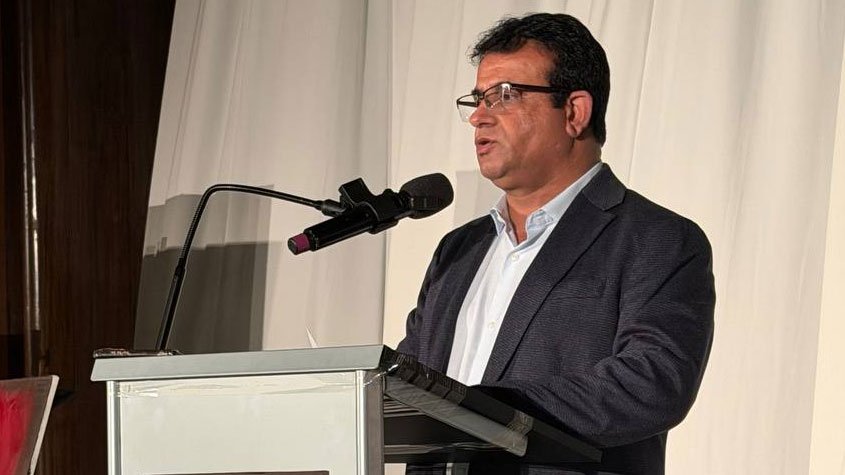
Dr Naseem Baloch, Chairman of the Baloch National Movement (BNM), said that Banuk Karima Baloch possessed exceptional clarity of vision and a deep political consciousness. Speaking at a seminar organised by the BNM in London to mark the fifth martyrdom anniversary of Banuk Karima Baloch, he stated that although the suffering of the Baloch, Sindhi, Pashtun, and Kashmiri peoples may appear different on the surface, the root cause is the same.
“At the centre of this suffering stands a Punjabi-dominated military state that calls itself Pakistan,” Dr Naseem Baloch said.
The seminar was attended by scholars and politicians from multiple countries, reflecting broad international participation and solidarity.
Dr Naseem Baloch said that Banuk Karima Baloch lived thousands of miles away from her homeland not by choice, but by compulsion. Remaining at home had become impossible, forcing her into exile. Yet even in exile, she did not seek comfort, silence, or personal safety.
“She went into exile in search of life — life for the thousands of Baloch who have been forcibly disappeared, and a dignified life for the millions who continue to live under occupation and humiliation every single day,” he said.
He stressed that this suffering is not abstract but the daily reality of oppressed peoples. “No nation chooses to live in chains. No human being accepts slavery willingly. A life lived under occupation is a life stripped of dignity, meaning, and hope — and it remains so until freedom is achieved,” he added.
Referring to Banuk Karima’s death, Dr Naseem Baloch said her martyrdom was tragic and painful, yet the Baloch nation does not mourn its martyrs in the way the world expects. “We draw strength from them. This, too, was Banuk Karima’s belief. Despite carrying immense grief, she never allowed sorrow to paralyse her. She did not retreat. She did not surrender. She turned pain into resistance and loss into resolve,” he said.
He emphasised that the anniversary should not be seen solely as a day of grief, but as a day of political reflection. “Banuk Karima Baloch was not merely a person whose life ended tragically. She was a conscious political act. Her life and her death exposed the reality of state oppression and the denial of nations,” he stated.
Dr Naseem Baloch criticised the Canadian government over Banuk Karima’s killing, noting that her martyrdom occurred in what is described as the civilised West. “Five years have passed, yet the truth behind her killing remains hidden,” he said. He also referred to the case of journalist and researcher Sajid Hussain, whose body was found in Europe, adding that justice has not been delivered in that case either.
“It is no coincidence that people like Banuk Karima and Sajid Hussain are murdered in exile,” he said. “Exile itself is an admission of failure by a state that has lost the ability to engage in dialogue and recognises only violence. We are political activists. We organised our society peacefully. Yet today, we live in exile.”
He added that had activists chosen armed resistance alone, they would be in the mountains of Balochistan rather than in London. “Pakistan treats every conscious individual from an oppressed nation as an enemy, leaving itself only one response: repression,” he said.
Dr Naseem Baloch noted that armed struggle is one part of the movement, but not its entirety. “Pakistan refuses to recognise this because it is not a democratic state. It is a military-colonial power,” he said, adding that Pakistan fears the collapse of its “unnatural structure” if it abandons its colonial model.
“That is why it suppresses thought, silences voices, and reduces entire nations to mere survival — stripped of dignity and denied the right to think freely,” he said, adding that Banuk Karima Baloch challenged this colonial order. “For this ‘crime’, she was first forced into exile. Even in exile, attempts were made to silence her. And finally, she was killed.”
Addressing Western governments, Dr Naseem Baloch questioned their selective approach to human rights. “If occupation in Ukraine is a crime, if oppression in Palestine is condemned, then under what law is occupation in Balochistan, Sindh, Pashtunkhwa, and Kashmir considered acceptable?” he asked. “Are human rights limited by geography, or has Pakistan been granted a special exemption from moral and legal accountability?”
Reiterating Banuk Karima’s vision, he said she understood that the Pakistani state does not merely occupy land. “It occupies our history. It occupies our language. It occupies our resources. It occupies our political authority,” he said.
He further stated that even beliefs are not free under this system. “Religion itself is reshaped and imposed according to military interests. When a state decides what you should believe, how you should pray, and how you should think, then one must ask: what remains of freedom?” he said.
Dr Naseem Baloch told participants that they had not gathered only to remember Banuk Karima Baloch, but because they believe in freedom. “It is the longing for freedom that has brought us together — the same freedom for which Banuk Karima sacrificed her life,” he said.
He declared in clear terms that freedom is not an extremist idea, not hatred, and not chaos. “Freedom is sacred. Freedom is natural. Freedom is the most basic human instinct,” he said.
Expressing hope for solidarity across nations, Dr Naseem Baloch said that if colonial interests were set aside, even a conscientious Punjabi would understand and support Baloch national freedom. “Baloch independence is not a threat to other nations. It is a promise — a promise that the age of occupation can end,” he said.
He recalled that Banuk Karima often warned that as long as oppressed nations view their struggles as isolated, the colonial state will continue to benefit. “Pakistan survives by dividing our pain, by isolating our resistance, and by turning our suffering into separate stories,” he said.
“We must not allow this to continue. We must become each other’s strength. This requires empathy — recognising that the suffering of one nation is the suffering of all. When empathy becomes shared, struggles unite, and when struggles unite, occupation weakens,” he added.
According to Dr Naseem Baloch, Banuk Karima’s politics were never limited to Balochistan alone. She understood that Pakistan’s crisis is not the crisis of one nation, but the outcome of a militarised colonial structure pretending to be a federation.
“This is a state that normalises enforced disappearances in Balochistan, extrajudicial killings in Sindh, collective punishment in Pashtun regions, and military sieges in Kashmir,” he said. “These are not mistakes or exceptions. They are necessities of a colonial system.”
He stressed that the peoples facing these policies are nations, not minorities. “What we face is not misgovernance; it is occupation,” he said, adding that the genocide in Balochistan, exploitation of natural resources, strangulation of the Indus River, manipulation of religion in Pashtun areas, and repression in Kashmir are deliberate policies.
Concluding his address, Dr Naseem Baloch said that Banuk Karima Baloch’s politics were rooted not in hatred, but in dignity. “She envisioned a future where Baloch, Sindhi, Pashtun, and Kashmiri peoples decide their own destiny on their own land,” he said.
Her message, he added, was simple and profound: true democracy cannot exist under the shadow of a gun and can only be born through the consent of nations.
“This anniversary reminds us that this struggle does not belong to one generation alone. It is a historical responsibility,” Dr Naseem Baloch said. “Until Pakistan’s colonial structure is dismantled and oppressed nations achieve freedom, peace in this region will remain an illusion.”

