


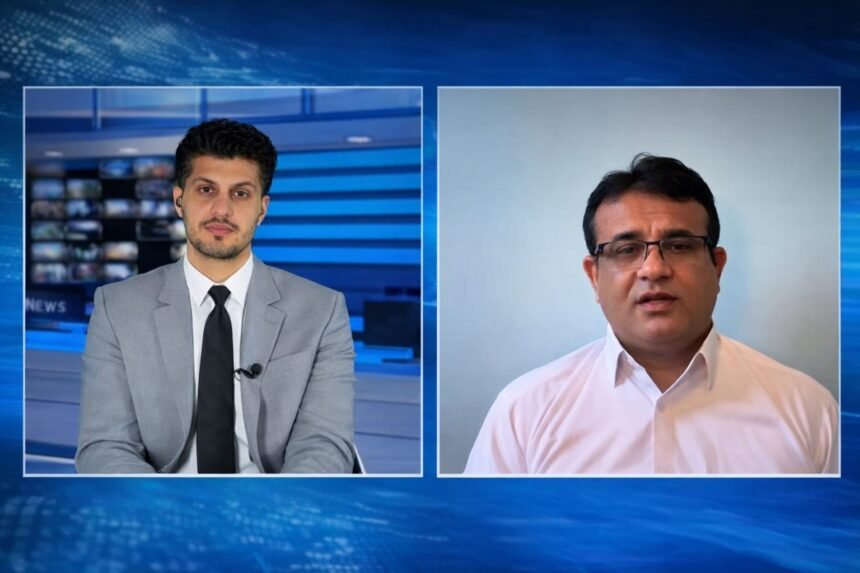
— An interview with Dr. Naseem Baloch on Rana TV
Note: Regarding the current situation in Balochistan and the Baloch national struggle, Mirwais Stanikzai of Afghanistan’s Rana TV conducted a detailed interview with Dr. Naseem Baloch, Chairman of the Baloch National Movement (BNM).
The interview was broadcast on 1 February 2025 on Rana TV’s satellite channel and YouTube. It was later transcribed into written form by the Information, IT and Cultural Department of the Baloch National Movement (BNM).
Mirwais Stanikzai :
Since 1948, the Baloch people have been struggling for their rights and freedom. Why has this struggle continued for so long?
Dr. Naseem Baloch:
This struggle did not begin yesterday, nor is it something temporary. It began on 27 March 1948, the day Pakistan forcibly occupied Balochistan through military action.
Balochistan had already declared its independence on 11 August 1947, but Pakistan sent its army and annexed the country against the will of the Baloch nation . From that day onward, resistance began—and it continues to this day.
For more than seven decades, this resistance has taken different forms, adapting to changing times and circumstances, but its core purpose has remained the same: ending forced occupation and reclaiming freedom.
Mirwais Stanikzai :
Pakistan claims that recent incidents in Balochistan are acts of terrorism. How do you respond to this accusation?
Dr. Naseem Baloch:
We want the world to clearly understand the difference between terrorism and a freedom movement.
The Baloch struggle is not terrorism. It is a legitimate movement of an indigenous people resisting colonial occupation. Pakistan routinely labels our resistance as terrorism to conceal its own failures.
Sometimes they blame India, sometimes Afghanistan, sometimes Iran—this is a repeated propaganda tactic. The truth is simple: Pakistan is trying to misrepresent a genuine freedom struggle.
Mirwais Stanikzai :
Who, then, is responsible for terrorism in the region?
Dr. Naseem Baloch:
If we speak honestly, terrorism is a product of Pakistan’s policies.
We have seen cross-border terrorism in Afghanistan, in Kashmir, and even inside Pakistan itself. Pakistan has attacked neighboring countries and has even killed Baloch refugees across borders.
The Baloch have never waged war in another country. Our struggle is confined strictly to Balochistan. Our politics, resistance, and sacrifices are rooted in our own land.
Mirwais Stanikzai :
Is there any possibility of resolving the issue through negotiations with Pakistan?
Dr. Naseem Baloch :
Pakistan is not a trustworthy state. Trusting Pakistan is like stabbing yourself in the foot.
History proves this. In the 1950s, Nawab Nauroz Khan was invited for negotiations under oath on the Quran. He came down from the mountains believing in dialogue—but Pakistan imprisoned him. His companions were hanged, and he himself died in prison at the age of 90.
This was not an isolated incident. Such betrayals have happened repeatedly. That is why negotiations without an international guarantor are meaningless.
Mirwais Stanikzai :
Under what conditions could dialogue become possible?
Dr. Naseem Baloch:
If the United Nations or an international guarantor intervenes and ensures the withdrawal of Pakistani forces from Balochistan, only then can a political process begin.
According to the UN Charter, occupied nations have the right to self-determination. If such a neutral guarantor steps in, the Baloch nation is ready to engage peacefully.
Mirwais Stanikzai :
Pakistan claims that Baloch rights can be achieved through parliamentary politics. Why has this failed?
Dr. Naseem Baloch:
Our elders tested Pakistan’s parliament and institutions for decades—and they failed.
Even today, Baloch parliamentarians openly admit that there is no benefit in remaining part of Pakistan’s political system. Whether it is Akhtar Mengal or Dr. Malik, they all acknowledge this reality.
The system offers nothing to the Baloch except repression.
Mirwais Stanikzai :
What is the current human rights situation in Balochistan?
Dr. Naseem Baloch:
The situation is catastrophic.
In 2025 alone, our human rights department Paank documented over 1,000 cases of enforced disappearances—an average of four to five people every day.
There were more than 200 extrajudicial killings in the same year. We have discovered mass graves in Panjgur, Khuzdar, Dera Bugti, and Tootak. In Tootak alone, 169 bodies were recovered, most unidentified.
This is nothing short of genocide.
Mirwais Stanikzai :
Why are women increasingly visible in the Baloch resistance?
Dr. Naseem Baloch:
When repression reaches its extreme, even those who traditionally remain away from conflict are forced to act.
Baloch women—mothers, sisters, wives—came onto the streets because their loved ones were disappeared or killed. Figures like Karima Baloch, Dr. Mahrang Baloch, and Sammi Deen Baloch represent this awakening.
Many of these women come from victim families. Yet even peaceful activism has been met with arrests and imprisonment. When every democratic space is closed, people are pushed toward harsher forms of resistance.
Mirwais Stanikzai :
What role has the international community played so far?
Dr. Naseem Baloch:
The international community has not done enough.
Global attention shifts from one crisis to another—Palestine, Syria, Ukraine—while Balochistan remains under a media blackout.
We have raised these issues at the United Nations, the European Union, and international human rights forums. Some statements are made, some letters are written—but real pressure is missing.
Mirwais Stanikzai:
What message do you want to send to the world about the current situation in Balochistan?
Dr. Naseem Baloch:
We want to make it clear that we will take firm steps to resist oppression and prevent it from continuing in the future. Through your platform, we want to convey this message to the world, to friends, and to all people: if the international community does not intervene, Pakistan will continue to behave as a ruthless and lawless state.
History shows that Pakistan’s army and its proxies were responsible for the killing of nearly three million people in Bangladesh. If this situation is not stopped now, Pakistan could attempt to repeat the same tragedy in Balochistan, as it did during the 1970s. If it does not happen today, it could happen tomorrow. Unless mass killings are prevented, the cycle of violence will continue and lead to further bloodshed.
Mirwais Stanikzai:
How do you see the role of political parties and the international community in this situation?
Dr. Naseem Baloch:
Political parties and the international community have a responsibility to intervene before history repeats itself. Silence and inaction only allow oppression to continue. Without international pressure, Pakistan will feel free to act without accountability.
Mirwais Stanikzai:
Pakistan often emphasizes its military strength. How do you respond to this?
Dr. Naseem Baloch:
Pakistan claims to have one of the largest armies in the world. But when we compare an army to a people, the reality is clear: Balochistan is a nation. A nation cannot be eliminated. Just as a nation cannot be destroyed, neither can its movement be crushed.
We cannot say exactly how many days or years it will take for Balochistan to be free. However, the steps taken by the Baloch nation across different platforms, and the multidimensional nature of our struggle, cannot be stopped by Pakistan’s military power. The larger the army, the more firmly we believe that it cannot defeat a nation.
History proves that wherever armies have tried to suppress nations, they have ultimately failed. The examples of the United States in Vietnam and Afghanistan clearly demonstrate this reality. It is impossible to defeat a nation through force alone. Today, we are moving steadily toward freedom. We are getting closer to our objective. The struggle we continue today will make it easier for our children tomorrow and bring them closer to achieving that goal.
Mirwais Stanikzai:
There is often discussion about conflict between Pakistanis and Balochs. How accurate is this portrayal today?
Dr. Naseem Baloch:
This portrayal is no longer accurate. This is not a conflict between Balochs and another nation, nor is it an ethnic conflict. Other nations within Pakistan face many of the same problems as the Baloch people. They, too, have launched civil rights movements, such as the Pashtun Tahafuz Movement (PTM).
These movements demand rights, justice, and dignity, and in many ways their struggle aligns with that of the Baloch people.
Mirwais Stanikzai:
In your view, how can other nations and the Baloch people cooperate to achieve shared goals?
Dr. Naseem Baloch:
Cooperation is possible through mutual recognition of shared suffering and shared demands for justice, dignity, and fundamental rights. Civil rights movements demonstrate that ordinary people clearly understand these common struggles.
Mirwais Stanikzai:
Can you explain the historical relationship between Balochistan and neighboring regions?
Dr. Naseem Baloch:
The relationship between the Baloch and Afghan peoples spans centuries. It is not something new. Balochistan existed as a country and a federation as early as the 17th century, and Afghanistan has also existed as a country for centuries.
When colonial powers such as the British and Portuguese arrived in the region, and when Balochs faced oppression in Balochistan, they sought refuge in Afghanistan. Likewise, when Afghans were oppressed, they sought refuge in Balochistan. This relationship has endured for hundreds of years.
We continue to respect and uphold this bond. Pashtuns and Balochs have historically supported one another, helping each other in difficult times. They are trustworthy neighbors with shared traditions. Today, movements such as the PTM speak openly about these shared struggles. We maintain good relations with them, as well as with our friends in Europe and Balochistan. Whenever we organize activities abroad, we support one another.
Mirwais Stanikzai:
Pakistan presents development projects, especially CPEC, as a solution for Balochistan. What is your response?
Dr. Naseem Baloch:
Pakistan claims it wants development for Balochistan and argues that prosperity will come once so-called security issues are resolved. They say they want Balochistan to be safe and developed. However, this so-called development is tied to a single project: the China–Pakistan Economic Corridor (CPEC). Balochistan has consistently opposed this project.
CPEC is nothing more than a joke. Its entire foundation begins with Gwadar. Without the Gwadar port, CPEC has no meaning. Yet look at the situation in Gwadar today—there is no access to clean drinking water. What kind of development can exist under such conditions?
Gwadar is central to CPEC, yet the port is effectively under Chinese control, while local people lack basic necessities. At the same time, authorities attempt to turn Gwadar into a restricted zone by fencing areas, limiting entry points, and subjecting residents to checkpoints and surveillance. This clearly demonstrates that the state does not trust the people of Balochistan.
