
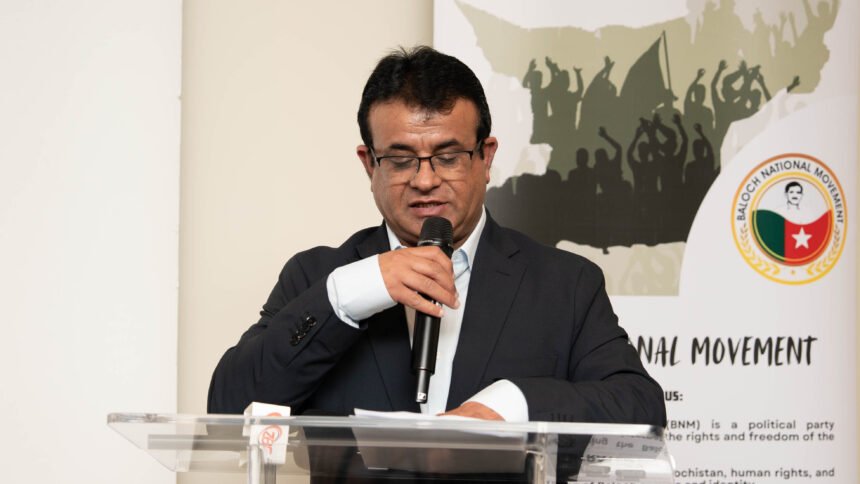
The Baloch National Movement (BNM) organized an international conference during the 61st session of the United Nations Human Rights Council in Geneva titled:
“Balochistan: Seventy-Eight Years of Occupation, Human Rights Violations, and the Failure of International Accountability.”
This was the party’s 11th international conference at the global level, held at the Rousseau Conference Hall of the Royal Hotel Geneva. The conference was attended by politicians, analysts, human rights advocates, and experts. It proved to be an important platform for discussing the political and humanitarian dimensions of the Baloch issue, as well as for promoting international awareness and solidarity.
Addressing the international conference, Chairman Dr. Naseem Baloch stated that today we have once again gathered to raise our voice against seventy-eight years of oppression, brutality, genocide, denial of national identity, and exploitation of national resources against the Baloch people. We are here in Geneva, where the United Nations is based, to mark an important milestone in our struggle for national freedom.
Dr. Naseem Baloch said that we are gathered in a hall named after the great philosopher and sociologist Jean-Jacques Rousseau, who famously said, “Man is born free, but everywhere he is in chains.” Today, we Baloch, as human beings, as individuals, and as a nation, are chained in subjugation. The United Nations is an organization of nations. Although the Baloch are not a state today, we meet every definition, criterion, and standard of a nation. We may not have a state today, but we had one in the past, and we firmly believe that we will have one again in the future.
He further stated that as Chairman of the Baloch National Movement, it is my responsibility to clearly tell the world that the Baloch nation is sacrificing lives for freedom. We are shedding blood for our collective survival. If the world stands with us, our suffering may be reduced; if not, we are left with no option but to die for our cause. He emphasized that BNM’s objective is clear: the freedom of Balochistan. It is our fundamental right over our land and a basic right for future generations.
We, gathered here thousands of kilometers away from our homeland, are determined to turn into reality the dream that was crushed in 1948 through force and violence. Our politics is not merely protest; it is the case of a living nation—the Baloch—and its national movement. It is a case for which thousands of young men and women are enduring torture in undisclosed detention centers. They suffer, they die, and their mutilated bodies are returned.
Pakistan has recently announced a policy of collective punishment. I want to clarify that although this announcement is recent, it has been implemented for the past two decades. Our entire leadership has been targeted, and our cadres and members have been killed in attempts to force us to abandon our struggle. However, the path to national freedom is irreversible—the Baloch nation will not step back even an inch. Today, we confidently declare that the Baloch nation is alive, united, and steadfast in its commitment to freedom.
Sardar Akhtar Mengal
“Pakistan has consistently violated its fundamental agreements with Balochistan.” — Sardar Akhtar Mengal, President of BNP
Addressing the conference, Sardar Akhtar Mengal stated that the issue of Balochistan is not recent. It did not emerge suddenly, nor is it an accident. It is the result of a long history that began with the creation of Pakistan. In 1948, an agreement was reached between Muhammad Ali Jinnah and the leadership of Balochistan, granting autonomy to Balochistan except in three areas: foreign affairs, defense, and currency. However, this agreement did not last long. Within months, the Khan of Kalat, Mir Ahmad Yar Khan, was arrested. For many, this was not just a political event but the first violation of the agreement—once the first clause is broken, everything that follows loses its foundation.
Manzoor Pashteen
“Human rights statistics reveal the brutality of the Pakistani state.” — Manzoor Pashteen, PTM
Manzoor Pashteen stated that when Baloch raise their voices against injustice, exploitation, and violence, they are labeled as traitors. Not only are activists punished, but ordinary civilians are also killed on their own land. He emphasized that once the real data on enforced disappearances and killings is presented, the true nature of the state becomes evident.
“Self-determination is a fundamental right of every nation.” — Mercè Monje
Addressing the BNM International Conference, Mercè Monje, Secretary General of UNPO, stated that UNPO is an organization that has been working for more than 35 years with nations and peoples who lack adequate representation in the international system. She emphasized that their work focuses on advocating for the right to self-determination of nations.
She noted that the title of today’s event reflects two important dimensions: occupation and human rights violations. This indicates a national-level issue, while also highlighting the failure of international accountability, which represents a problem at the global system level. She began her remarks from this perspective.
She explained that the international system, particularly the United Nations, is a state-based system. It is states—not nations—that are represented, while peoples and nations are often left behind. This is the reality faced by all UNPO members, who lack effective means to participate, to have a voice, or to seek justice at the international level.
She further stated that both the Baloch and Sindhi peoples are long-standing members of UNPO, and this reality is clearly reflected in their struggles. They are distinct nations with their own identities, histories, and political status, yet they do not have meaningful participation in decisions that directly affect their lives. This exclusion is where many of these problems originate.
She concluded by emphasizing that when the right to participate at both national and international levels is denied, the right to self-determination is also denied. According to UNPO, self-determination is not merely a political outcome; it is the fundamental right of nations to effectively participate in decisions regarding their political, economic, social, cultural, and environmental futures.
“Pakistan is a criminalized, militarized, and authoritarian state.” — Dr. Ayesha Siddiqa
Addressing the BNM International Conference, King’s College fellow, researcher, and scholar Dr. Ayesha Siddiqa stated that every year BNM makes a significant effort to bring people together and unify voices so that Balochistan is not forgotten—so that its suffering is remembered and the international community does not overlook a crisis that is alive, bleeding, and in urgent need of attention.
She said that Pakistan is a criminalized, militarized, and authoritarian state, and this must be stated clearly. Unfortunately, it does not believe in dialogue. In Pakistan, the military is in complete control and remains the ultimate decision-maker. The reality is that the Pakistani state has become increasingly more brutal over time.
She further added that she has closely observed BNM, attended its meetings, and has been invited to various events across Europe. Each time, she has learned something new and witnessed progress. However, she emphasized that the time has now come to bring all minds together, develop a more organized strategy, and reflect on where they want to see Balochistan in the next ten to fifteen years.
“Balochistan’s pain is real, and it will be free.” — Andy Vermaut
Addressing the BNM International Conference, human rights activist, journalist, and Chairperson and Editor of PostVersa, Andy Vermaut, stated that it is an honor for him to speak in Geneva at the invitation of Dr. Naseem Baloch. He said that we are gathered in a city that is regarded as a symbol of law, conscience, and human dignity—a city where the language of justice is spoken through treaties, resolutions, and formal declarations.
He added that this is why he has submitted a request to the European Parliament to review Pakistan’s GSP status, because trade cannot come at the cost of human dignity. He further stated that Balochistan reminds us of another truth: when men are disappeared, women carry the struggle forward. Daughters march, sisters speak out, and mothers do not give up. They carry photographs and turn memory into resistance.
He emphasized that this resistance is important because no nation can be erased forever. History does not forget the disappeared. History remembers, and history delivers its judgment. No occupation lasts forever, and no (oppression) continues indefinitely.
Anna Lorena Delgadillo-Pérez (UN WGEID)
Addressing the BNM International Conference, Anna Lorena Delgadillo-Pérez, a member of the United Nations Working Group on Enforced or Involuntary Disappearances (UN WGEID) and a human rights lawyer, stated that she is a member of the UN Working Group on enforced or involuntary disappearances. She expressed her pleasure at being present and sharing some of the violations that the Working Group, along with other UN special procedures, has been documenting in the province of Balochistan over the past several years.
She said that they have documented alleged arbitrary arrests of Baloch people, cases of enforced disappearances, extrajudicial killings, excessive use of force, and the misuse of administrative and legal counterterrorism measures against the Baloch population. Some of these violations, she noted, have also been documented during protests and in public spaces in recent months.
She further stated that the Working Group has historically documented cases from the Balochistan region. However, they are deeply concerned because, over the past few months and the last year, there has been a noticeable increase in cases of enforced disappearances as well as extrajudicial killings in the region.
Gary Cartwright
Gary Cartwright, Publisher/Editor of EU Today and former adviser to UK MEPs
Addressing the BNM International Conference, Gary Cartwright, Editor and Publisher of EU Today, stated that over the past three days they have participated in the UN Human Rights Council sessions, conferences, and related activities. He said he wanted to use this opportunity to share some thoughts based on his 64 years of experience and observations, particularly on the importance of political processes and elections.
He further stated that, as part of their campaign, they prepared a white paper titled “An Analysis of Pakistan’s Non-Compliance with GSP+ Obligations.” He noted with satisfaction that the Directorate-General for Trade of the European Commission has accepted it as evidence for its upcoming consultations. He added that for many years they received no response, but this time their efforts have finally yielded results.
He emphasized that human rights campaigns are, in essence, political campaigns. Therefore, when people say that as human rights activists one should stay out of politics, this is incorrect. Human rights are politics. Inflation is politics. Children’s education is politics. Security is politics—everything is political. When we speak about politics, we are speaking about human rights. People often try to separate the two, but in reality, they are closely connected; the difference lies only in objectives, strategies, and timeframes.
Hidayat Bhutto (World Sindhi Congress)
Addressing the BNM international conference, Hidayat Bhutto, a leader of the World Sindhi Congress, congratulated the Baloch National Movement on organizing this important and timely conference. On behalf of the World Sindhi Congress, he expressed his gratitude for providing a platform to express solidarity. He stated that Sindh and Balochistan not only share borders but also centuries-old historical, cultural, and fraternal ties.
He said that today they are connected by an even deeper bond—shared suffering, the pain of oppression, the brutality of state violence, and the continuous denial of fundamental rights. The atrocities committed by Pakistan’s state agencies equally affect both the Baloch and Sindhi nations.
He further stated that thousands of people in Balochistan have been forcibly disappeared, and countless individuals have fallen victim to extrajudicial killings. The discovery of mass graves and mutilated bodies has become a tragic yet ongoing reality. Collective punishment has been in practice since the very inception of Pakistan. Villages are targeted, families are destroyed, and voices are silenced.
He cited the recent abduction of BNM Chairman Dr. Naseem Baloch’s father and uncles as a clear reminder that no one is beyond the reach of state repression. He emphasized that the struggle of the Baloch people is not carried by men alone; brave Baloch women stand at the forefront of this struggle, demonstrating extraordinary courage and resilience.
Sherbaz Khan (Awami Workers Party, Gilgit-Baltistan)
Addressing the BNM international conference, Sherbaz Khan, a leader of the Awami Workers Party Gilgit-Baltistan, stated that the situations in Gilgit-Baltistan and Balochistan are similar—marked by the same kind of occupation, systematic exploitation of resources, and many other issues that both regions are enduring with pain. On behalf of the Awami Workers Party Gilgit-Baltistan, he expressed full support for BNM’s struggle and activities, adding that he also conveyed this support on behalf of his leader, Baba Jan.
Sherbaz Khan said that today he stands before the audience with the firm belief that their struggle is not limited to a single region, nation, or border; rather, it is a global movement for humanity, justice, and freedom. Although Gilgit-Baltistan is geographically far from Balochistan, the reality is that despite the distance, their suffering, deprivation, and shared oppression bind them together.
He concluded by stating that they pledge to raise their voices further, strengthen their unity, and continue their struggle for their rights before the world. Wherever possible, they will stand with each other, become each other’s voice, and move forward together in this struggle.
Saqlain Imam (Journalist)
“The Baloch movement is a legitimate struggle, and it is the fight of every freedom-loving person.” — Saqlain Imam
Addressing the BNM international conference, journalist Saqlain Imam said that it was an honor for him to be among people who are struggling for their freedom and rights. He stated that this is not only the struggle of the Baloch people but, in his view, it represents the struggle for freedom of every individual in Pakistan.
He said that Pakistan, even after its so-called independence, has not truly been free. Initially, it remained under British influence and later became part of American Cold War policies, as a result of which the entire country has remained under external influence.
He further added that people from Gilgit-Baltistan, Sindh, Balochistan, and Pashtun regions are all raising their voices for their rights, and these regions can be considered oppressed territories. He noted that Punjab is also, to some extent, part of the same system, with the difference that due to close ties with military institutions, conditions there are relatively different, while in other provinces the situation is more severe.
Speaking about the constitutional status of Gilgit-Baltistan, he said that it is still not fully recognized under Pakistan’s constitution, while Balochistan, despite being constitutionally part of Pakistan, is deprived of its fundamental rights.
He cited the example of Dr. Mahrang Baloch, who has been detained without any formal charges under administrative orders, calling it a violation of Pakistan’s own constitution and evidence of weak rule of law.
Sharing his experience as a journalist, he said that there is a complete media blackout in Balochistan. Journalists are not allowed to report the truth, and if they attempt to do so, they risk abduction or even death. As a result, the world remains unaware of the actual situation in Balochistan.
He also highlighted the deteriorating state of journalism in Pakistan, noting that the country’s global ranking has fallen significantly and that journalists face threats from state institutions, armed groups, and other actors.
He stated that sanctions often harm the public while strengthening those in power, and therefore the international community should reconsider its engagement with Pakistan’s military establishment.
In conclusion, he reiterated that the Baloch movement is a legitimate struggle and the fight of every freedom-loving individual. He praised the determination of the Baloch people, stating that a nation with such passion cannot be defeated.
“Last year in Balochistan, 1,355 people were forcibly disappeared and 225 were extrajudicially killed.” — Hatem Baloch, PAANK BNM
At the BNM international conference, Hatem Baloch, coordinator of the human rights organization PAANK, said that their work involves investigating human rights violations in Balochistan, documenting them, and raising awareness. Their focus is on enforced disappearances, illegal killings, and collective punishment. Balochistan has been facing a severe and ongoing human rights crisis not just today but for the past 78 years.
According to PAANK’s recorded data for 2025, 1,355 cases of enforced disappearances were documented, 225 people were extrajudicially killed, and 407 were later released.
From January 2026 to March 20, 2026, 228 cases of enforced disappearances were recorded, along with 81 extrajudicial killings, including over 21 young people killed in Panjgur. These are not just numbers; they represent human lives—lives of individuals and their families.
He appealed to international organizations and authorities to investigate human rights violations in Balochistan, pressure Pakistan to end enforced disappearances, hold perpetrators accountable, review international relations, suspend Pakistan’s GSP Plus status in light of these violations, and provide sustained support to affected families. He emphasized that Balochistan can no longer silently endure.
The conference was moderated by Saleem Baloch and Mehra Baloch.
Footages :
