
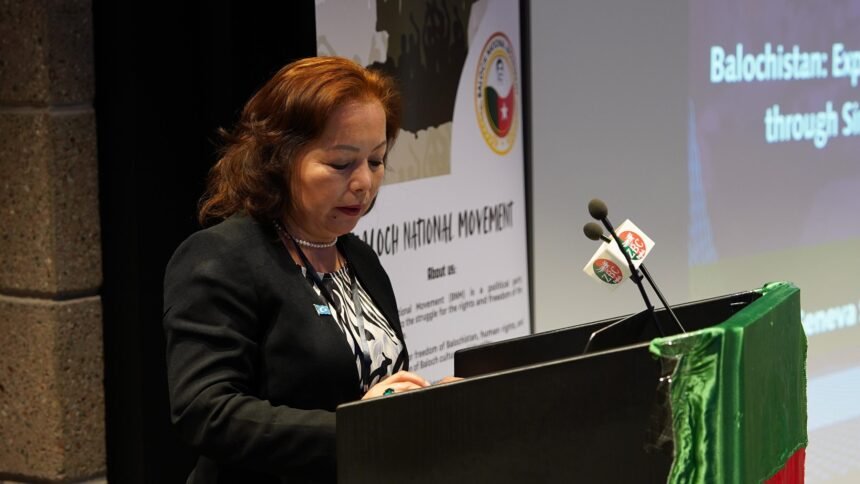
“There are striking similarities between the atrocities and tactics used by dictators and oppressors throughout history,” stated Rahima Mahmut in an address at the 5th Balochistan International Conference of Baloch National Movement (BNM). Speaking to activists and scholars, Mahmut emphasized the shared struggles between the Baloch and Uyghur people, drawing parallels between China’s ongoing genocide of the Uyghur people and the exploitation of Balochistan through the China-Pakistan Economic Corridor (CPEC).
“I left my country in 2000, after 1997, and I’ve been in exile ever since. Since 2017, I’ve been unable to return and have been banned from speaking to my family. You can imagine the pain and suffering I have endured, along with my people,” Mahmut explained, underscoring the deep personal cost of China’s oppressive policies.
Mahmut, a Uyghur human rights activist, focused much of her speech on CPEC, a project often lauded for promoting economic development between China and Pakistan. However, she warned the audience about its hidden dangers, particularly its role in furthering exploitation, displacement, and environmental destruction in Balochistan, all for China’s benefit. She noted, “CPEC has primarily served China’s interests while plunging Pakistan into deeper economic dependence,” leaving regions like Balochistan impoverished despite their natural wealth.
Drawing from historical context, Mahmut illustrated how China’s occupation of East Turkestan (what China calls Xinjiang) and Pakistan’s colonization of Balochistan in the mid-20th century mirrored one another. Both regions are rich in resources but have seen little benefit for their local populations, as their lands are exploited by their central governments. The genocide of Uyghurs in East Turkestan, marked by mass internment camps that have imprisoned over a million Uyghurs since 2014, is part of China’s broader agenda to dominate the region for its Belt and Road Initiative (BRI), of which CPEC is a major component.
“The genocide is not just about the Uyghurs asserting ownership of their land, but about China’s larger ambitions,” Mahmut said, pointing out that the Chinese Communist Party’s (CCP) vision for global dominance via the BRI has directly impacted both the Uyghur people and the Baloch people, connecting the two struggles.
She also delved into the environmental and social costs Balochistan has endured due to CPEC, echoing the devastation seen in East Turkestan. “Local communities are losing their land and livelihoods to Chinese companies under the guise of development,” she noted, adding that the economic corridor has led to large-scale displacement and further impoverishment of the Baloch people, much like how Uyghur lands have been stripped for Chinese exploitation.
Mahmut urged unity between oppressed nations like the Baloch, Uyghurs, and Tibetans, stating, “We share common enemies.” She highlighted the necessity of collaboration in fighting the oppressive regimes that continue to exploit their lands, emphasizing that the international community must not ignore these interconnected struggles.
In her concluding remarks, Mahmut called for accountability on China’s human rights abuses and Pakistan’s complicity in these violations. “Acting alone, our voices may be weak, but I believe that if we unite, we can be much stronger,” she concluded.
Rahima Mahmut is a Uyghur human rights activist, translator, and singer. She has played a key role in raising awareness about the ongoing genocide against the Uyghur people and has worked closely with survivors, including interpreting testimonies for the Uyghur Tribunal. Rahima serves as the Executive Director of Stop Uyghur Genocide, UK Director of the World Uyghur Congress, and Advisor to the Inter-Parliamentary Alliance on China (IPAC).
Click the link below to read her complete speech:
