


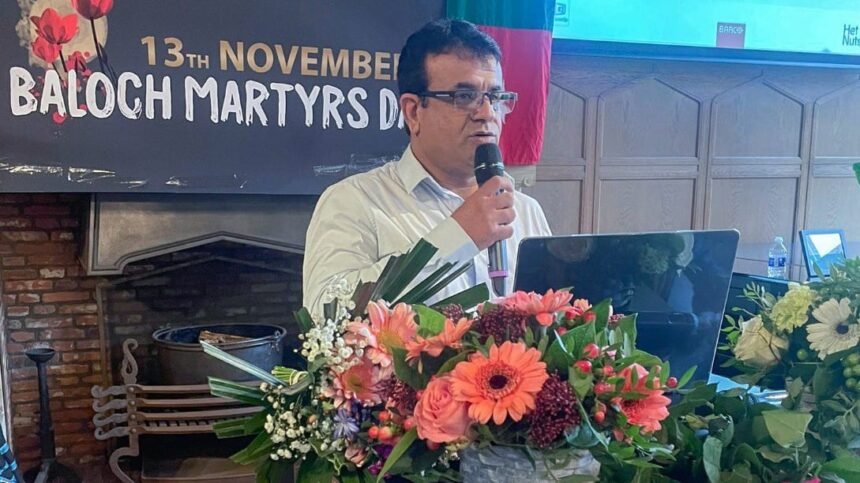
Dr. Naseem Baloch, Chairman of the Baloch National Movement (BNM), stated that armed resistance is not a new phase in the Baloch national movement but rather a continuation of a longstanding historical struggle. Whenever the Baloch nation has faced threats to its land, identity, or national existence, it has embraced resistance as a sacred obligation. From defiance against British colonialism to the current battle against Pakistani occupation, Baloch fighters have upheld this movement with sacrifice, dignity, and unyielding national pride.
He emphasized that today’s armed resistance has grown in both intensity and organization, effectively challenging the Pakistani military through popular support, disciplined tactics, and guerrilla operations. Baloch Sarmachars now frequently establish checkpoints on major highways, target military convoys, and control roads for hours—often without any visible presence of Pakistani forces. After these operations, the state typically retaliates by inflicting violence on civilians, including elders, women, and children. This reaction, Dr. Baloch asserted, reflects the military’s intellectual, strategic, and moral collapse.
According to Dr. Naseem Baloch, the Pakistani state has become incapable of confronting the national movement and its core guerrilla resistance. In response, it has entrenched a policy of enforced disappearances, collective punishment, extrajudicial killings, and mutilation of bodies. Even more disturbing is the shift from covert “death squads” to openly sanctioned terrorist groups operating under the guise of “peace militias.”
He explained that for years, these so-called death squads—criminal gangs backed by the military and intelligence agencies—have been embedded into Baloch society to sabotage the national movement. Their tactics include abductions, targeted killings, intimidation, and the instigation of tribal and social conflict. These operations, while destructive, have failed to deliver the strategic goals envisioned by the state.
Now, Dr. Baloch warned, the same objectives are being pursued more openly through “peace forces” under the cover of the so-called provincial government. For example, in the Rakhni area, a militia led by Aftab Bugti, brother of Sarfraz Bugti, recently attacked Baloch Sarmachars, resulting in the martyrdom of four. This incident is a clear indication that the state is increasingly dependent on mafias, tribal militias, and contract killers.
More alarming, he added, is the Pakistan army’s reported collaboration with international terrorist groups such as ISIS. Camps and training facilities for ISIS are being established in various parts of Balochistan, for use not only against the Baloch movement but also to destabilize the broader region. These actions demonstrate that Pakistan is not only supporting terrorism but actively facilitating it. This is not just a local threat—it poses a danger to international peace and security.
In light of these developments, Dr. Naseem Baloch issued the following calls to the international community:
- The training and deployment of death squads, “peace militias,” and religious terrorist groups under state patronage are flagrant violations of international human rights. Immediate international intervention is necessary.
- The establishment and use of ISIS camps in Balochistan are a direct threat to regional stability. The United Nations and regional powers must act decisively and urgently.
- The collective punishment of Baloch civilians—including abductions, the dishonoring of women and children, and extrajudicial killings—are war crimes and must be prosecuted before the International Criminal Court (ICC).
- The Baloch National Movement (BNM) will continue to expand its political and resistance efforts—through writing, public engagement, and diplomacy—on all international forums.
- We appeal to all human rights organizations, democratic institutions, civil society actors, journalists, intellectuals, and the global conscience to recognize the unfolding tragedy in Balochistan, document Pakistan’s crimes, and work to hold the state accountable under international law.
Dr. Naseem Baloch concluded by declaring:
“Balochistan today is a test for the world. This is a moment to choose between standing with the oppressor or standing with the oppressed. The Baloch nation is fighting for survival—for their land, language, identity, and freedom. This is not merely a conflict of arms, but a battle for justice, dignity, and humanity. The Baloch National Movement will continue this struggle on every front.”
