


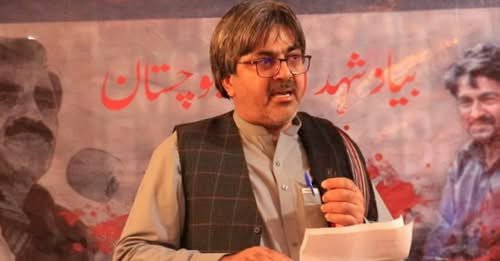
The Secretary General of the Baloch National Movement, Dil Murad Baloch, has strongly condemned Pakistan’s bombing of a hospital in Kabul, calling it “deeply shameful and inhumane.” He stated that Pakistan’s military aggression on Afghan soil constitutes a direct attack on Afghanistan’s sovereignty, a serious war crime, and is highly condemnable. He emphasized that in this difficult time of war, the Baloch National Movement stands in solidarity with the brave Afghan nation.
He further said that the relationship between the Baloch nation and the people of Afghanistan is not merely one of geographical proximity, but one rooted in history and brotherhood. “Our history bears witness that we have stood by each other in every difficult moment. We are custodians of these traditions, and today as well, the Baloch people stand firmly with their courageous neighbors,” he added.
Dil Murad Baloch stated that Pakistan, in its arrogance of military power, has forgotten that it is confronting Afghanistan — a country that defeated the Soviet Union, and more recently, the world’s superpower, the United States, along with the largest military alliance, NATO.
He said that Pakistan initiated these attacks under baseless pretexts, but the world is aware that Pakistan’s core issue lies in the Durand Line and its inability to accept a free and sovereign Afghanistan. The Durand Line predates the creation of Pakistan and involves three primary stakeholders: Pakistan, Afghanistan, and the Baloch. It cannot be resolved unilaterally according to the interests of any one party. Various forms of government have existed in Afghanistan — monarchy, communism, religious, and presidential systems — yet despite their differences, all Afghan governments have remained consistent on the issue of the Durand Line. This is why the issue remains unresolved.
He further stated that even after serving as a proxy for nearly two decades, Pakistan failed to resolve the Durand Line issue through its alignment with the United States and NATO. The fundamental reason, he said, is that existential national issues are resolved by nations, not by governments. No nation willingly allows a part of its existence to be severed at the hands of an adversary, and this is precisely the stance the Afghan nation continues to uphold.
Dil Murad Baloch stated that Pakistan’s second major issue is an independent and sovereign Afghanistan. Whether it was the decision to join the Western alliance against the Soviet Union or later align with the United States and NATO, Pakistan has on one hand sustained its economy through rented alliances, while on the other hand actively contributed to the destruction and destabilization of Afghanistan.
The objective has been to prevent Afghanistan, as a state, from becoming stable and independently shaping its national destiny and interests. For decades, Pakistan has treated Afghanistan as “strategic depth” within its military doctrine, ensuring that there is no perceived threat from the so-called Durand Line, and that Afghanistan’s sovereignty remains subordinated to what are described as Punjabi-dominated interests.
He concluded by stating that Afghanistan has effectively thwarted both of Pakistan’s objectives. Today’s Afghanistan neither accepts Pakistan’s concept of strategic depth nor recognizes the Durand Line as an international border. As a result, Pakistan is exploiting regional tensions and its role as a proxy of Western powers to carry out aggression against Afghanistan. “History shows that it is not Afghanistan that surrenders its weapons, but Panjabis — and history can repeat itself at any time,” he concluded.

