
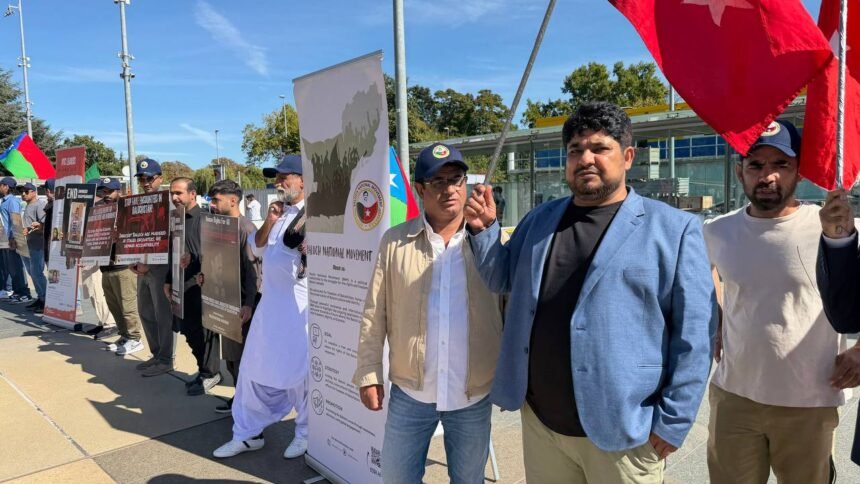
The Baloch National Movement (BNM) held a protest rally in Geneva against enforced disappearances, human rights violations, extrajudicial killings, and the sentencing of political activists in fabricated cases in Balochistan.
Participants in the protest rally gathered outside the United Nations Office at the Broken Chair, where speakers called for international attention to the human rights situation in Balochistan, Sindh, Pakhtunkhwa and Kashmir. The protest was part of BNM’s September 2026 Geneva campaign, aimed at highlighting the Balochistan issue on the international stage. With representatives of nations living under the Pakistani system of rule taking part, the BNM campaign extended beyond Balochistan, emerging as a collective campaign of the oppressed nations of the region, with representatives from Sindh, the Pashtun community, Gilgit-Baltistan and Kashmir joining the protest.
During BNM’s three-day special campaign in Geneva, BNM representatives also participated in demonstrations organised by Pashtuns and Sindhis, expressed solidarity with them, and described joint struggle for freedom as the path to liberation.
Addressing the BNM protest in Geneva were BNM Chairman Dr Naseem Baloch, Foreign Secretary Faheem Baloch, Central Junior Joint Secretary Hassan Dost Baloch, Foreign Department Focal Person Hakeem Baloch, Sarang Haider, Europe Chapter Coordinator of Voice for Missing Persons of Sindh, human rights activist Noor Maryam Kanwar, and Kamran Jatoi of the World Sindhi Congress.
The speakers said that people had come to Geneva from different parts of the world to express solidarity with mothers who had been waiting for years for the return of their forcibly disappeared children.
According to the speakers, these mothers “do not close their doors and cannot sleep properly” because they continue to wait for their sons and daughters.
The speakers said that fathers hold back their tears in front of others over the disappearance of their sons, but “when they sit alone, they cry deeply and remember their children.”
They said that sisters also cannot eat and drink normally because their brothers are being held in “dark and torturous cells.”
The speakers said that crimes against humanity continue in Balochistan and that no distinction is made on the basis of age or gender.
According to them, “thousands of people are being abducted, thousands are being killed, and bodies are being thrown onto the streets.”
They said the issue was not limited to the Baloch, but that Pashtuns, Sindhis and Kashmiris were also suffering from the same situation.
“We have to unite. We have to bring our voices together. Pashtuns, Baloch and Sindhis are all together. Whether in Gilgit-Baltistan, Sindh, Pakhtunkhwa or Balochistan, we are all oppressed and we are all suffering.”
The speakers said Balochistan had been “a land of suffering for decades” and that, according to them, human rights violations had continued since 1948, followed by further periods of repression in 1962, 1973 and 2006.
They said that thousands of Baloch had been subjected to enforced disappearances and extrajudicial killings.
According to them, “Balochistan has been turned into a military cantonment, and all freedoms and legal rights of the local people have been taken away.”
The speakers also referred to enforced disappearances and extrajudicial killings in Sindh and Khyber Pakhtunkhwa.
They said that over the past decades, “more than 3,500 enforced disappearances and more than 100 extrajudicial killings have been reported in Sindh,” while “more than 100 nationalist activists remain forcibly disappeared, and the number of ordinary citizens is four times higher.”
The protesters and speakers called on the United Nations to intervene in Balochistan, Sindh, Khyber Pakhtunkhwa, Kashmir and Saraiki Waseb and to send an independent fact-finding mission.
They said that the issue of enforced disappearances and human rights violations was no longer confined to Balochistan but had spread to Khyber Pakhtunkhwa, Kashmir and other major cities across the region.
The speakers said that the people of united India had achieved independence from British colonial rule in the 1940s, but now, “we are being forced to live under a new form of the same colonialism.”
Referring to Frantz Fanon, the speakers described opportunists and colonial intellectuals as forces that had taken control of people’s lives.
“They have taken away the right to live, and the right to die in peace and dignity.”
According to the speakers, following killings, the bodies of victims are not handed over to their families, while families are pressured into signing horrific agreements.
They said that “not enough is said about the terrifying reality of everyday life.”
The speakers said that it was not only Baloch, Pashtun and Sindhi activists who were being targeted, but also lawyers who represented their cases.
Referring to Imaan Mazari and her husband, Hadi Chatha, they said they were being harassed because they had taken up cases on behalf of families of forcibly disappeared Baloch and Pashtun people.
The speakers said, “There is no rule of law in Pakistan. There, power itself is the law, and that power is the Pakistan Army.”
They also referred to social activist Sabeen Mahmud, saying that she was “killed simply because she held a session with the families of forcibly disappeared persons. Half an hour later, she was shot in Karachi.”
The speakers said that the families of activists such as Mahrang, Bebo, Gul Zadi, Bebagar and Sibghatullah were also subjected to collective punishment, adding that they were harassed, suppressed and, at times, killed.
At the conclusion of the protest, the speakers once again called on the United Nations to take immediate and meaningful action on Balochistan.
They called for independent investigations and urged the United Nations not to ignore enforced disappearances, collective punishment and pressure on affected families.
Speakers from Sindh, Pakhtunkhwa and other regions who participated in the protest described the situation in Balochistan as a shared human rights issue and said that the voices of affected nations and families must be heard at the international level.