

BNM Chairman meets Committee members and submits detailed dossiers during Pakistan’s review at the CESCR in Geneva
Dr Naseem Baloch, Chairman of the Baloch National Movement (BNM), raised serious human rights violations in Balochistan with members of the UN Committee on Economic, Social and Cultural Rights (CESCR) during Pakistan’s second periodic review. He called on the Committee to hold Pakistan accountable for failing to meet its international obligations. He also urged the United Nations to set up a dedicated mechanism to investigate and monitor human rights violations in Balochistan, and to give the Baloch nation a formal platform where its voice can be heard directly.
Dr Naseem Baloch met Committee members Michael Windfuhr and Julieta Rossi and told them about enforced disappearances, extrajudicial killings, collective punishment, and the denial of basic economic, social and cultural rights to the Baloch nation. He said these conditions cannot be separated from Pakistan’s systematic repression of the Baloch nation.
Describing enforced disappearances and collective punishment in detail, he said thousands of Baloch families have lived through this ordeal, and its effects reach far beyond the direct victims. Families lose their breadwinners, children lose their chance at an education, and entire households are pushed into poverty.
He also raised concern over the imprisonment of Baloch human rights defenders, including Dr Mahrang Baloch and other leaders of the Baloch Yakjehti Committee (BYC). He cited the sentences handed to Imaan Mazari and her husband Hadi Ali Chattha as an example of how harshly peaceful people who speak up for Baloch rights are punished.
Citing Article 1 of the International Covenant on Economic, Social and Cultural Rights (ICESCR), Dr Naseem Baloch reminded the Committee that all peoples have the right to self-determination, including the right to freely dispose of their natural wealth and resources. He also referred to Articles 11, 12 and 13, which protect the rights to an adequate standard of living, health and education.
Challenging Pakistan’s claim to be meeting these obligations, he asked: “How can Pakistan claim compliance while these rights are being denied in Balochistan?”
He told Committee members: “We are not asking for sympathy. We are demanding justice, accountability and our fundamental rights.”
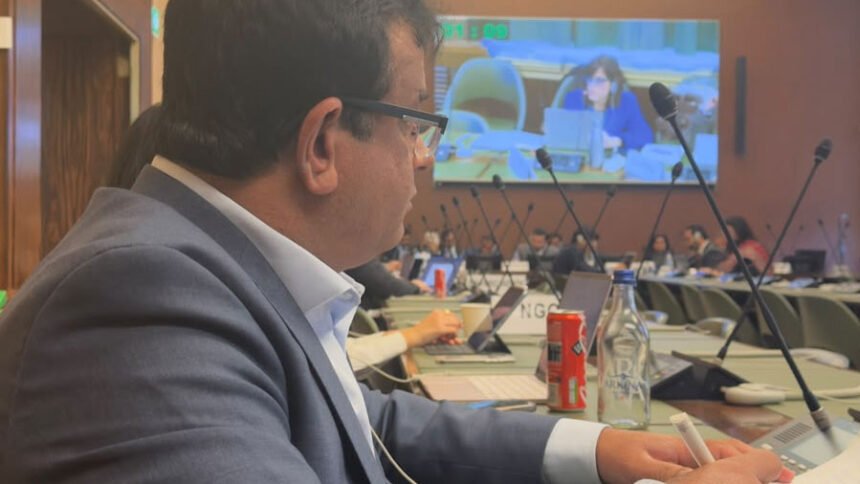
Dr Naseem Baloch also attended the Committee’s formal review session, where a Pakistani delegation of about 12 representatives appeared to answer questions on the country’s implementation of the Covenant. During the session, Julieta Rossi repeatedly asked about the situation in Balochistan, and Michael Windfuhr also raised issues concerning the region. Their questions made Balochistan part of the Committee’s formal review of Pakistan.
At the end of the session, Dr Naseem Baloch gave further dossiers to the Committee Chair and to members L. E. Perez and Fiorio Vaesken. The dossiers set out human rights violations in Balochistan and what they mean under the Covenant.
Fiorio Vaesken showed particular interest in the documents. He reviewed them himself, pointed out several issues that fall within the Committee’s mandate, and assured Dr Naseem Baloch that he would raise these matters before the Committee the next day.
