The European Parliament’s Committee on Petitions has declared admissible a petition filed by Jamal Baloch, media coordinator of Paank, the human rights department of the Baloch National Movement (BNM), concerning serious human rights violations in Balochistan and Pakistan’s GSP+ trade preferences. The committee acknowledged that the matter raised falls within the European Union’s fields of activity.
GSP+ and Pakistan
Petition and dossier submitted by Jamal Baloch to the European Parliament’s Committee on Petitions.
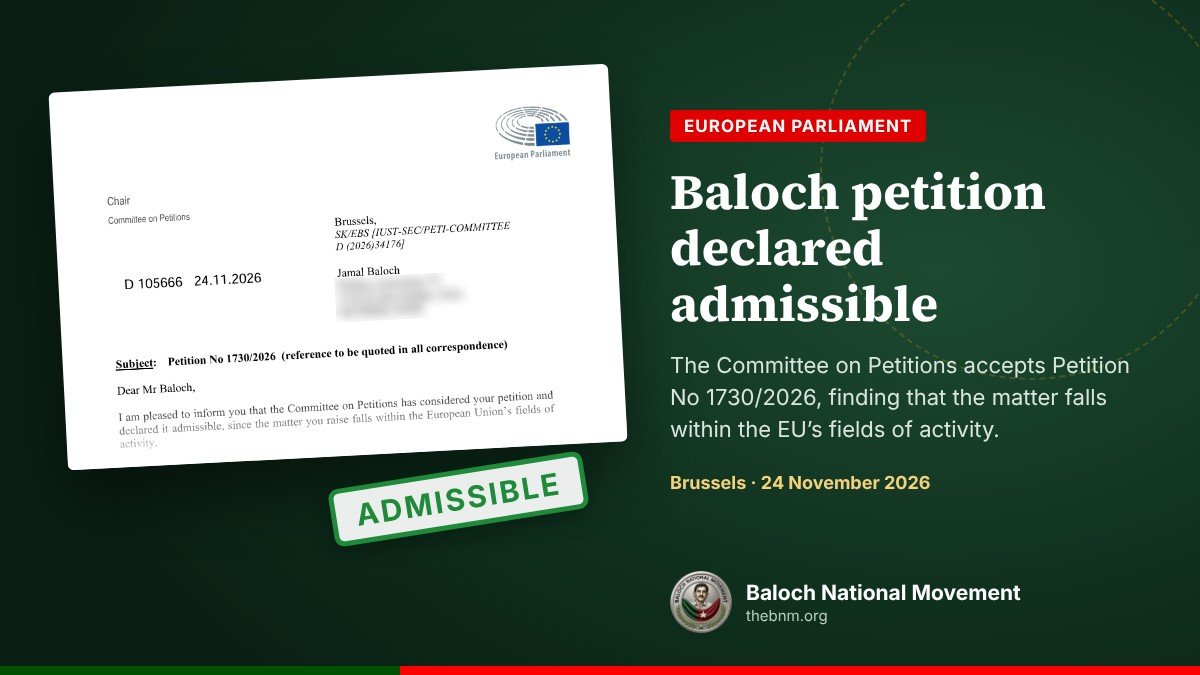
Petition No 1730/2026 declared admissible
Letter from the Chair of the Committee on Petitions, Brussels, 24 November 2026: the petition falls within the European Union’s fields of activity.
In a formal letter dated 24 November 2026, Committee Chair Bogdan Rzońca informed Jamal Baloch that Petition No 1730/2026 is admissible because it falls within the EU’s competence. According to the letter, the committee has forwarded the petition for further information to the European Parliament’s Committee on Foreign Affairs and the Subcommittee on Human Rights, and has also sent a letter to the Parliament’s Delegation for Relations with the countries of South Asia.
The committee chair referred in the letter to the European Commission’s GSP+ assessment of Pakistan for the period 2023-2025, published on 16 July 2026. The report expresses serious concerns about enforced disappearances across Pakistan including in Balochistan, extrajudicial killings, lack of accountability, restrictions on freedom of expression and peaceful assembly, the potential for arbitrary arrests under counter-terrorism laws, and the right to a fair trial.
The letter also referenced the 15th EU-Pakistan Joint Commission meeting held in Brussels on 17 December 2025 and the seventh EU-Pakistan Strategic Dialogue held on 21 November 2025. These meetings discussed Pakistan’s implementation of the 27 international conventions required under GSP+, as well as enforced disappearances, freedom of expression, media freedom, judicial independence and fundamental human rights.
The committee further drew Jamal Baloch’s attention to written questions raised in the European Parliament regarding possible violations of international obligations by Pakistan and the potential suspension of GSP+, along with the European Commission’s replies. These include parliamentary questions on enforced disappearances in Balochistan and Pakistan’s compliance with international conventions.
Declaring the BNM petition admissible and forwarding it to the European Parliament’s committees dealing with foreign affairs and human rights represents a significant step in bringing the matter before the relevant institutions of the European Parliament.
Jamal Baloch had submitted a detailed dossier to the European Parliament’s Committee on Petitions on 3 July 2026, titled “Human Rights in Balochistan and the Case for Suspending Pakistan’s GSP+ Status”. The document provides a detailed review of the human rights situation in Balochistan, enforced disappearances, extrajudicial killings, state actions against political activists and human rights defenders, and the GSP+ trade preferences granted to Pakistan.
The dossier argues that Pakistan, despite receiving trade preferences under GSP+, is not effectively complying with the 27 core international conventions whose implementation is mandatory for obtaining and retaining these preferences. The document calls on the European Union to initiate the procedure for the temporary withdrawal of Pakistan’s trade preferences under Article 19 of the GSP Regulation.
According to the dossier, thousands of Baloch students, political activists, journalists, intellectuals and ordinary citizens have been subjected to enforced disappearances over the past two decades. The document alleges that security personnel take people from their homes, educational institutions and public places and transfer them to unknown locations, where they are held in illegal detention for long periods. Some of the forcibly disappeared have later been found dead with signs of torture. The dossier characterises these incidents as a state-level “kill-and-dump” policy.
The document also details the Baloch Yakjehti Committee’s Long March from Turbat to Islamabad in 2023 and 2024, which was launched in protest against the extrajudicial killing of young Baloch man Balach Mola Bakhsh. According to the dossier, family members of the forcibly disappeared, particularly women, played a prominent role in the protest, but upon reaching Islamabad the peaceful demonstrators faced water cannons, baton charges, tear gas and mass arrests.
Referring to the life sentences handed down in June 2026 to Baloch Yakjehti Committee leaders Dr Mahrang Baloch and Sibghatullah Shah, the dossier raises serious questions about the transparency of the judicial proceedings and the requirements of a fair trial. According to the document, the cases were conducted inside prison, where independent media, observers and lawyers did not have proper access. It also includes allegations regarding Dr Mahrang Baloch’s solitary confinement and the denial of adequate medical facilities.
The dossier further details travel bans, surveillance and continuous harassment directed at human rights activist Sammi Deen Baloch. According to the document, on 28 June 2026 armed personnel raided her home in Karachi, seizing laptops, documents and other personal belongings.
The dossier calls on the European Union to take five basic steps. These include initiating the procedure for the temporary suspension of Pakistan’s GSP+ status; applying diplomatic pressure for the release of Dr Mahrang Baloch, Sibghatullah Shah and other detained human rights activists; protecting human rights defenders including Sammi Deen Baloch from state harassment and restrictions; requesting the establishment of a United Nations independent investigative mission to examine enforced disappearances and extrajudicial killings in Balochistan; and conditioning future financial and trade assistance to Pakistan on verifiable improvements in the human rights situation.
The Baloch National Movement maintains that the trade preferences granted to Pakistan under GSP+ are conditional upon the protection of human rights and the effective implementation of the relevant international conventions, but that the serious ongoing human rights violations in Balochistan are in clear contradiction with these conditions.
Through an organised and coordinated global campaign, the BNM continues to raise the situation in Balochistan, enforced disappearances, extrajudicial killings, political repression and the denial of Baloch national rights at European countries, the European Parliament, the United Nations and other international forums. The petition submitted by Jamal Baloch to the European Parliament is also part of this global campaign.
According to the BNM, the European Parliament’s decision to declare the petition admissible and forward it to the relevant parliamentary committees is an important development in this ongoing diplomatic and political effort. As a result of the BNM’s continuous work, the Balochistan issue is being discussed at European and other international forums, and Pakistan is facing accountability before the international community regarding the human rights situation in Balochistan.
However, the BNM says that practical steps are needed beyond the mere expression of concerns and diplomatic dialogue. The BNM calls on the international community, and particularly the European Union, to give an effective and concrete response to the ongoing human rights violations in Balochistan, to hold Pakistan accountable to its international obligations, and to take practical measures for the protection of human rights.