Week
Week: the latest updates
Wednesday 11 November 2026
BNM Gives Top Priority to Enhancing the Skills of Its Members: Dr. Naseem Baloch Addresses Capacity Building Meeting
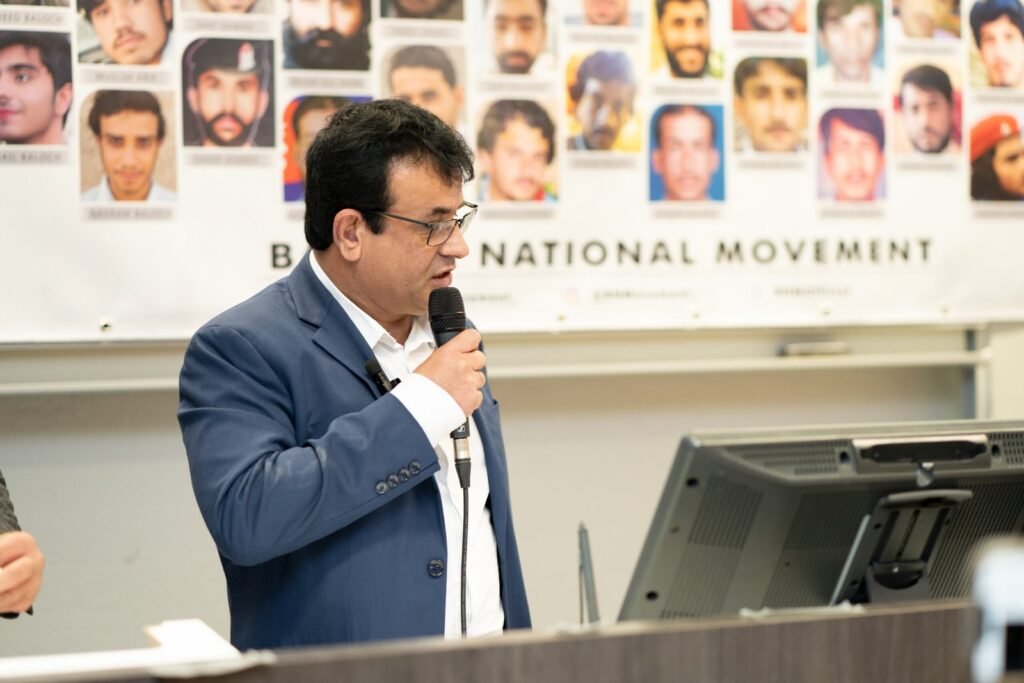
A meeting of the Capacity Building Advisory Council, the capacity-building institution of the Baloch National Movement (BNM), chaired by BNM Chairman Dr. Naseem Baloch. The meeting was attended by Dr. Jalal Baloch, who is in charge of BNM’s training and education affairs, along with presidents and general secretaries of chapters established in various countries and regions. The purpose of the meeting was to review the activities and performance of the Education and Training Department over the past four years, and to discuss the future course of action.
Dr. Naseem Baloch shed detailed light on the importance and utility of the institution and, praising its overall performance, said that it is our good fortune to be members of a party that has always given top priority to improving the capabilities of its members and helping them flourish.
Dr. Naseem Baloch further said that, thanks to the institutional framework devised for the party at the Council Session, the party’s various institutions are now performing their work well. Owing to the performance of these institutions, a batch of cadres has been prepared over the past four years, and it is essential for the success of any party that it has successors to its cadres and leaders.
During the meeting, Hafeez Baloch, focal person of the Capacity Building Council, presented the four-year performance report. He highlighted the various training activities, programs, and workshops organized by the institution. According to the report, over the past four years, 499 study circles were held on various topics, of which 30 were at the central level and 469 programs at the zonal and chapter levels. In addition, four workshops on different topics were also successfully conducted during this period.
On this occasion, discussion was also held on the need to make organizational activities more effective, improve coordination among the various chapters, and carry the training process forward with continuity. Participants stressed that training and capacity building at the organizational level are important for the effective functioning of any political organization.
The meeting also considered the future course of action. In this regard, proposals were discussed on holding training diwans, workshops, and other intellectual and organizational activities in the future, improving the performance of chapters, and making the work of the training institution better organized.
BNM Vice Chairman and constitutional head of the Department of Education and Training, Dr. Jalal Baloch, said that the political and intellectual training of workers is of fundamental importance for the strength and effective progress of any political movement. The Capacity Building institution is playing an important role in refining workers’ abilities, raising organizational awareness, and aligning them with the demands of the national movement. He stressed that all chapters will have to play a more active role to make this process more effective and organized.
In conclusion, he said that over the past four years our institution has not only succeeded in holding four hundred and ninety-nine (499) study circles, but significant progress has also been made on the party syllabus, with four books and six booklets published. All of this was made possible by the hard work and intellectual maturity of the members of the Capacity Building Council team.
Tuesday 10 November 2026
No International Investment in Balochistan’s Mineral Resources Will Be Accepted Without the Consent of the Baloch Nation: BNM Spokesperson
The spokesperson for the Baloch National Movement (BNM) has expressed serious concerns over the Pakistan Minerals Investment Forum (PMIF26), scheduled to take place in Islamabad on November 12–13, stating that Pakistan seeks to transform the exploitation of Balochistan’s natural resources into an international economic enterprise by involving foreign investors and multinational corporations. Held under the banners of investment and development, the forum is, in reality, an attempt to deprive the Baloch nation of its own resources and perpetuate its poverty, deprivation, and economic subjugation. We describe this as mineral colonialism, a system in which external powers reap the benefits of a region’s natural wealth while its indigenous population is subjected to exploitation and marginalisation.
The spokesperson stated that no foreign investment, mining project, or extraction of natural resources in Balochistan can be considered acceptable without the free, genuine, and collective consent of the Baloch nation. Any agreements concluded by disregarding the will and political status of the Baloch nation will remain illegitimate and unacceptable, further deepening the ongoing conflict and potentially escalating violence in the region. We urge all international mining companies, investors, and financial institutions to refrain from investing in Balochistan. Balochistan is an occupied territory and a region experiencing an ongoing conflict. Under these circumstances, the international community has a moral and political responsibility to support the Baloch nation’s right to self-determination and their struggle for freedom, rather than becoming complicit in the economic interests of an occupying state.
The spokesperson further stated that enforced disappearances, extrajudicial killings, unlawful arrests of political activists and leaders, fabricated criminal cases, and systematic attempts to silence political voices in Balochistan form part of a broader system aimed at suppressing the political and economic rights of the Baloch nation and maintaining control over its natural resources. For decades, the Baloch nation has struggled for its national identity, its homeland, and the right to exercise control over its resources. The continued sacrifices of Baloch men, women, and youth are a testament to the enormous human cost of this struggle. Claims of development and prosperity in Balochistan that disregard these realities are nothing more than an illusion. International companies must recognise that exploiting Balochistan’s resources without the consent of the Baloch nation risks making them complicit in a contested and exploitative enterprise.
The BNM spokesperson called upon the United Nations, international financial institutions, and the wider international community to make the free consent of the Baloch nation a fundamental condition for any project involving Balochistan’s natural resources, to take notice of human rights violations, and to respect the political and national rights of the Baloch nation. The spokesperson emphasised that Balochistan is not a mineral colony; it is the homeland of the Baloch nation. The right to decide the fate of its resources belongs to the Baloch people, not to an occupying state or its international partners. Any project imposed against the will of the Baloch nation will only perpetuate exploitation, resistance, and further instability. Genuine peace, development, and prosperity in Balochistan can only be achieved through the freedom and self-determination of the Baloch nation and its sovereign control over its own natural resources
Monday 9 November 2026
Paank Report: Nearly 5,000 People Forcibly Displaced from Shadi Kaur, Pasni
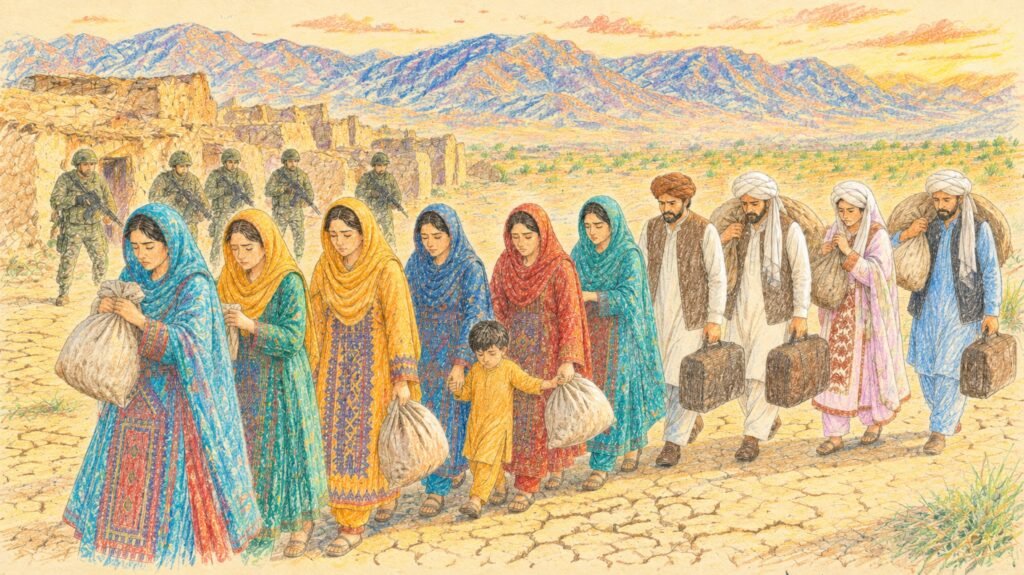
Paank, the human rights body of the Baloch National Movement (BNM), says in its latest report that almost the entire population of Shadi Kaur in Pasni tehsil, Gwadar district, around 5,000 Baloch residents, was forcibly evicted from their ancestral lands on 11 and 12 July 2026.
According to the report, the displacement followed military actions, enforced disappearances, mass detentions, restrictions on the supply of essential goods, and evacuation orders issued by the Pakistan Army. On 9 and 10 July, army personnel ordered residents to leave their homes and warned that the houses of anyone who stayed would be burned.
Aggression and Human Rights Violations
Paank states that on 5 May 2026, Pakistan Army and affiliated intelligence personnel detained between 85 and 100 men. The detainees were reportedly tortured, made to lie in the sun, and had stones forced into their mouths when they cried out. About 40 of them were taken to a military camp near the Shadi Kaur Dam and forcibly disappeared. Many remain forcibly disappeared in military custody.
The report says a three-day military siege from 5 to 8 May restricted movement in Shadi Kaur, Zarin Kaur, Trati, Gorestani and Kabadi. During this period, eight people, including women and children returning from medical treatment, were held for two days. Throughout May and June, food and household supplies were repeatedly turned back at the Gabdi checkpoint.
The report also names Sardil, son of Sher Khan, who was forcibly disappeared by Pakistani military intelligence personnel on 22 November 2025. His mutilated body was found near Pasni on 30 May 2026.
Human and Cultural Impact
According to Paank, the displaced Baloch families have been forced to move to Pasni, Hormara, Turbat and surrounding towns, where many are living in tents. Roughly 10,000 acres of farmland have been abandoned, severely affecting agriculture, food security, education, healthcare and traditional livelihoods. The report says the displacement threatens the Baloch people’s ancestral bond with their land and the intergenerational transmission of their cultural and historical identity.
A Wider Pattern of Repression
Paank says it documented 1,355 enforced disappearances and 225 extrajudicial killings in 2025. Between January and June 2026, it recorded 556 enforced disappearances and 227 extrajudicial or custodial killings. The organisation adds that in October 2026, an evacuation order was also issued for about 30,000 people in Shor Parood, in the Kalat region.
International Legal Obligations and Recommendations
The report argues that the violations raise serious concerns under the International Covenant on Civil and Political Rights (ICCPR), the International Covenant on Economic, Social and Cultural Rights (ICESCR), the Convention against Torture, the UN Guiding Principles on Internal Displacement, and Article 10 of the UN Declaration on the Rights of Indigenous Peoples.
Paank calls for an immediate end to forced evictions, disclosure of the whereabouts of the disappeared, independent investigations, and humanitarian assistance. It also calls for guarantees of the safe, voluntary and dignified return of the local Baloch population.
Open as a separate page: Paank Report: Nearly 5,000 People Forcibly Displaced from Shadi Kaur, Pasni