
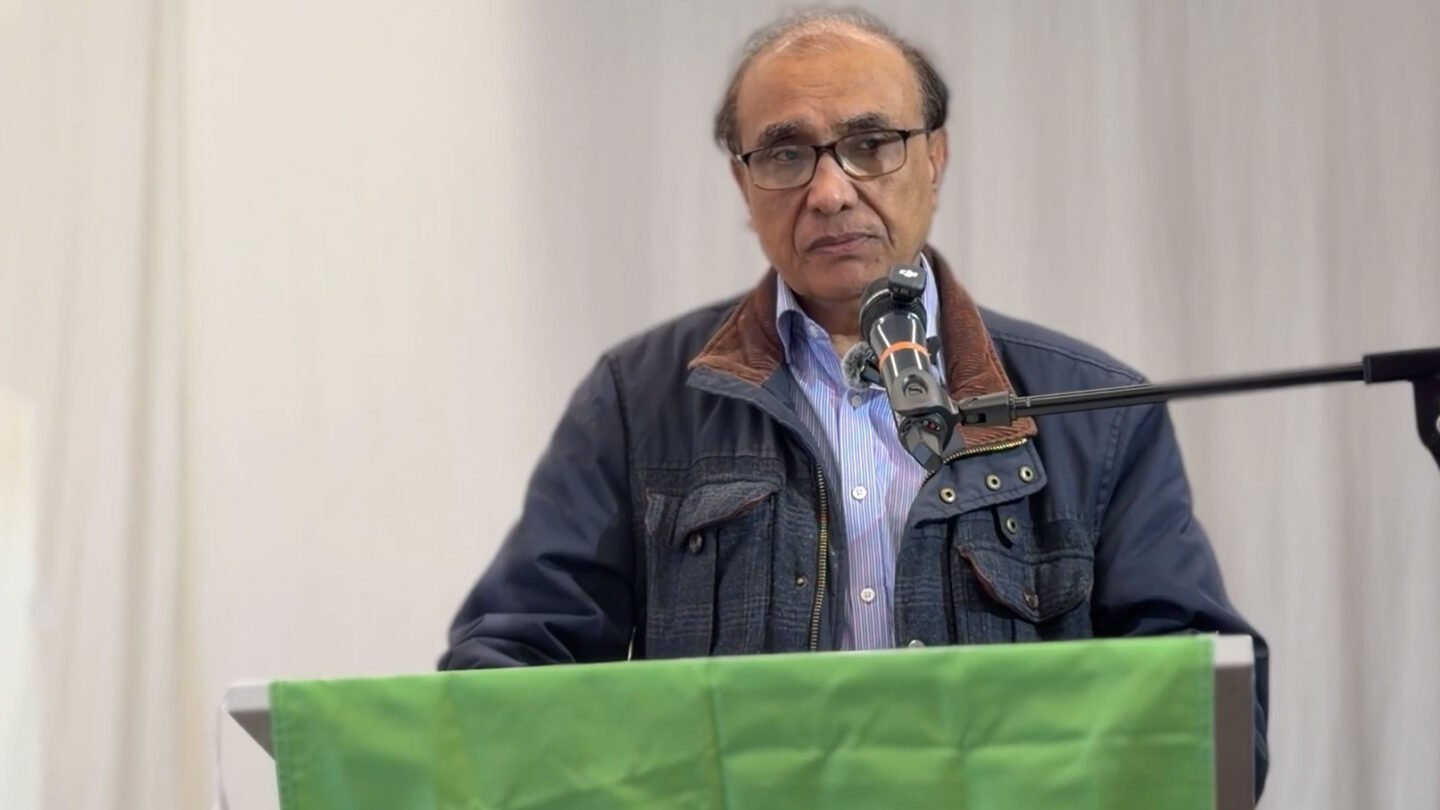
The chairman of the World Sindhi Congress has told a conference in Germany that the sacrifices of Baloch martyrs have transformed Baloch society and that the current situation in Balochistan amounts to a form of “fascist colonialism”.
Dr Lakhu Luhana, speaking at a Baloch National Movement (BNM) event in Hannover marking Baloch Martyrs’ Day, said the martyrs gave their lives so that their nation could live in freedom, peace and dignity on its own land. He described periods of subjugation as the darkest times in the history of nations, but said the martyrs showed that no people can be kept in chains indefinitely if they refuse to accept them.
He argued that the sacrifices have produced what he called a “magic” in Baloch society: the rise of a middle-class leadership and a significant role for women. He said thousands of women are now active in the struggle for rights and freedom, an internal liberation that would otherwise have taken decades or centuries.
Luhana rejected the description of the situation as mere internal colonialism. He said the phenomenon has changed form over time and that Balochistan is now under what he termed fascist colonialism driven by Punjabi chauvinism and the overwhelming dominance of the army. He claimed that politicians are not elected but employed by the military, that parliament and the judiciary have been hollowed out, and that the ruling elite is morally bankrupt.
He said the state’s economic model rests on the extraction of resources from oppressed nations and on foreign funds obtained by acting as a proxy. With those external sources weakening and Pakistan’s economy under severe strain, he argued, the military’s greed has deepened and it is now seeking to take almost everything that remains — land, minerals and water — from Balochistan and other regions. He cited reports of millions of acres of land being taken and mineral samples being offered for sale abroad.
Luhana linked the increased desperation of the state to a rise in enforced disappearances, extrajudicial killings, collective punishments and pressure on relatives of activists living abroad. He noted that international attention to human rights has diminished as global powers face their own problems. He also observed that struggles are growing among Baloch, Pashtuns, Sindhis and even in Pakistan-administered Kashmir because people see no other option for survival.
Quoting the late Sindhi leader G.M. Syed, he said consistent, honest work with clear strategy and commitment would eventually cause the system to make mistakes and weaken. He described the Baloch and Sindhi struggles as mutually reinforcing and said the martyrs of one nation are the martyrs of the other. He ended by expressing hope that freedom, dignity and peace would come sooner rather than later through continued commitment and strategy.