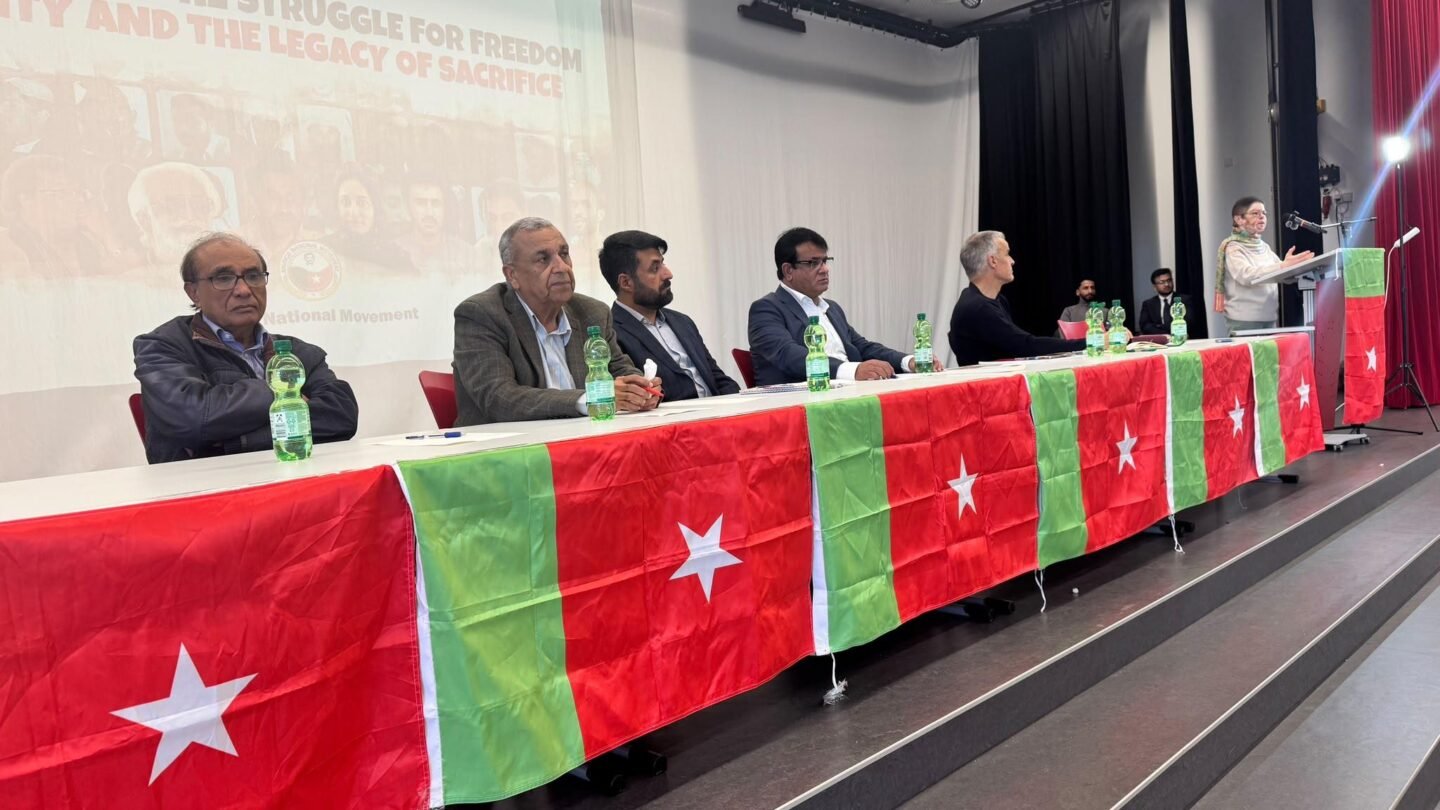
The Baloch National Movement (BNM) held a conference in Hannover, Germany to mark Baloch Martyrs’ Day. The event was titled “Balochistan: The Struggle for Freedom, Identity and the Legacy of Sacrifice.” It was moderated by Saleem Baloch and Nadeem Saleem.
BNM Chairman Links Baloch Independence to Regional Stability and Calls on West to Review Its Policies
BNM Chairman Dr Naseem Baloch said the demand for Baloch independence was not only a national issue but a strategic question for the wider region. He described Balochistan as a vast, resource-rich territory of exceptional strategic importance at the crossroads of South Asia, Central Asia and the Middle East, with strong traditions of religious tolerance and cultural diversity. Despite these characteristics, he said, the political and national rights of the Baloch people, including their right to determine their own future, had consistently been overlooked in the regional strategies of global powers. He linked the issue historically to 19th-century imperial expansion and the end of colonialism in the 20th century, and argued that Western support for Pakistan during the Cold War and the later sponsorship of religious militant groups after the Soviet intervention in Afghanistan had produced consequences far beyond Afghanistan.
Ignoring the Baloch national question, he said, had been a fundamental political and strategic failure of Western policies. He presented the BNM’s position that an independent, secular, democratic and sovereign Balochistan could play a fundamental role in promoting regional cooperation, economic connectivity and political balance. He urged Western powers to stop viewing the Balochistan issue merely through the lens of Pakistan’s internal affairs and to recognise the Baloch National Movement as a serious political actor. Turning to the organisation’s own history, he recalled the heavy price paid in the form of killed leaders and activists, including former chairman Ghulam Mohammed and Central Committee member Dr Abdul Rashid Baloch, as well as arrests, enforced disappearances, exile and continuous political pressure.
Paank Presents Figures of Over 1,900 Enforced Disappearances and Hundreds of Killings
The coordinator of Paank Hatim Baloch presented figures of 1,355 enforced disappearances and 225 extrajudicial killings in 2025, and a further 556 disappearances and 227 killings in the first half of 2026. He also referred to a government briefing that reported 60,000 military attacks between January and October 2026.
Sindhi Congress Leader Calls Situation in Balochistan Fascist Colonialism Driven by Army Dominance
World Sindhi Congress chairman Dr Lakhu Luhana paid tribute to Baloch martyrs and said their sacrifices had strengthened middle-class and women’s participation. He called the current situation “fascist colonialism” driven by army dominance and Punjabi chauvinism, and said the Baloch and Sindhi struggles reinforced each other.
Dr Naseer Dashti Warns Rare-Earth Minerals Could Turn Balochistan into Contested Arena for Major Powers
Writer Dr Naseer Dashti said commemorating martyrs was not enough and that the younger generation must understand why Balochistan had suffered for nearly 180 years. He traced the region’s history through the Great Game, the Cold War and the Afghan conflict, and warned that the discovery of rare-earth minerals would turn Balochistan into a contested arena for major powers.
Spanish Journalist Highlights Media Blackout and Risks Facing Local Reporters in Balochistan
Spanish journalist Karlos Zurutuza highlighted what he called a media blackout on Balochistan. He cited cases of foreign reporters being expelled, the killing of local journalists, and figures from Freedom Network that at least 40 journalists had been killed in the province over two decades. He said practical support for local reporters through secure channels was more useful than appeals to the United Nations.
Political Analyst Ayesha Siddiqa Describes Pakistan as a Colonial and Rent-Seeking State
Political analyst Ayesha Siddiqa said she no longer trusted the Pakistani state to protect its citizens. She described it as a colonial and rent-seeking state that had taken the form of “constitutional militarism,” and linked enforced disappearances to the control of mineral resources.
Cambridge Researcher Describes Situation in Balochistan as Internal Colonialism
Cambridge researcher Rafi Ullah Kakar, speaking via Zoom, described the situation as “internal colonialism.” He pointed to manufactured leadership, an extractive economic model and a coercive security policy, and criticised the reported pressure on tribal leaders to form their own militias.
BNM Germany Chapter President Thanks Guests and Speakers
Asghar Baloch, president of the BNM Germany chapter, thanked the guests and speakers.
In addition to the Hannover event, the Baloch National Movement held programmes to mark Baloch Martyrs’ Day in the Netherlands, Awaran, Kech and Gwader.