


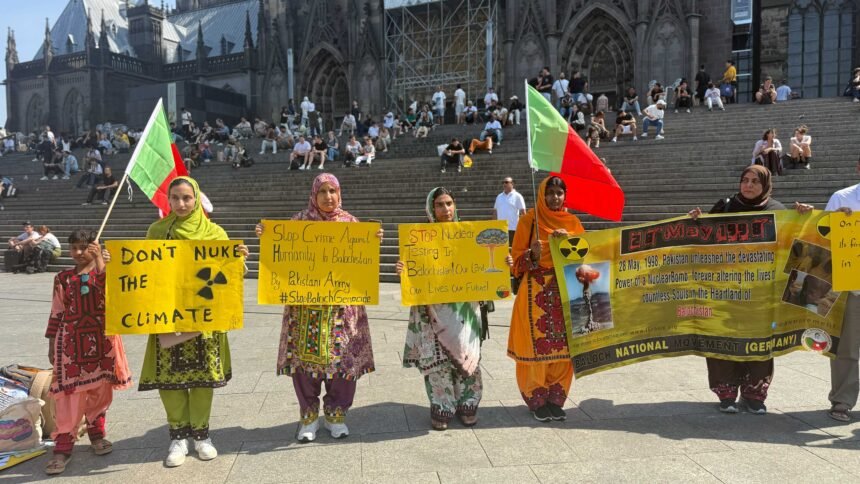
Köln, Germany — The Baloch National Movement (BNM) organized a demonstration in Köln, Germany, to protest against the nuclear tests conducted by Pakistan in Chagai, Balochistan, on 28 May 1998, and to highlight their long-term environmental, humanitarian, and political consequences.
Members of the Baloch diaspora participated in the protest and raised awareness about the devastating impacts of the nuclear tests on the people, environment, and future generations of Balochistan.
During the demonstration, speakers delivered speeches in both English and German, emphasizing the environmental destruction, health crises, political oppression, and humanitarian challenges faced by the residents of Chagai and surrounding areas following the nuclear tests conducted by Pakistan.
Addressing the gathering, speaker Akbar Baloch stated that the people of Balochistan remember 28 May not as a day of celebration but as a painful chapter in their history. He said that the mountains of Chagai still bear witness to the suffering caused by the nuclear explosions, whose consequences continue to affect generations. He paid tribute to Baloch martyrs, forcibly disappeared persons, political prisoners, and families enduring years of pain and uncertainty. He emphasized that nations survive through sacrifice, justice, and humanity rather than through weapons.
Mujeeb Abdullah Baloch, speaking in German, highlighted that the nuclear tests brought fear, disease, and long-term suffering to many families in Balochistan. He stressed that the environment and natural landscape of the region were severely damaged.
Speaker Asif Baloch stated that 28 May is observed in Balochistan as a day of mourning. He criticized Pakistan’s continued expansion of its nuclear weapons program and warned that such policies pose a serious threat to regional and global peace. He stated that the nuclear tests were carried out in a neglected and impoverished region without adequate safety measures, evacuation plans, or long-term health studies. According to him, local communities continue to suffer from cancer, congenital illnesses, environmental degradation, climate-related hardships, and economic devastation. He urged the international community to take a principled stand on nuclear accountability and to support efforts aimed at maintaining regional and global peace through nuclear disarmament.
Luqman Baloch stated that the people of Balochistan continue to suffer from the consequences of the nuclear explosions conducted in the Chagai Mountains. He said that the tests not only damaged the environment and natural resources but also exposed local communities to serious health risks and long-term humanitarian challenges. He stressed that nuclear weapons pose a threat not only to Balochistan but also to regional and global peace. He called for independent investigation teams from the European Union and the United Nations to be granted access to Balochistan in order to examine the humanitarian, ecological, and health impacts of the nuclear tests.
Participants chanted slogans against the Pakistani state and urged international and European organizations to conduct independent investigations and scientific research into the climatic, environmental, and humanitarian conditions in Chagai and other affected regions of Balochistan.
The organizers also distributed informational pamphlets in English and German among members of the public to further raise awareness of the issue.
The speakers reiterated their call for international attention to the suffering of the people of Balochistan and urged global human rights and environmental organizations to play an active role in addressing the consequences of nuclear testing in the region.
